
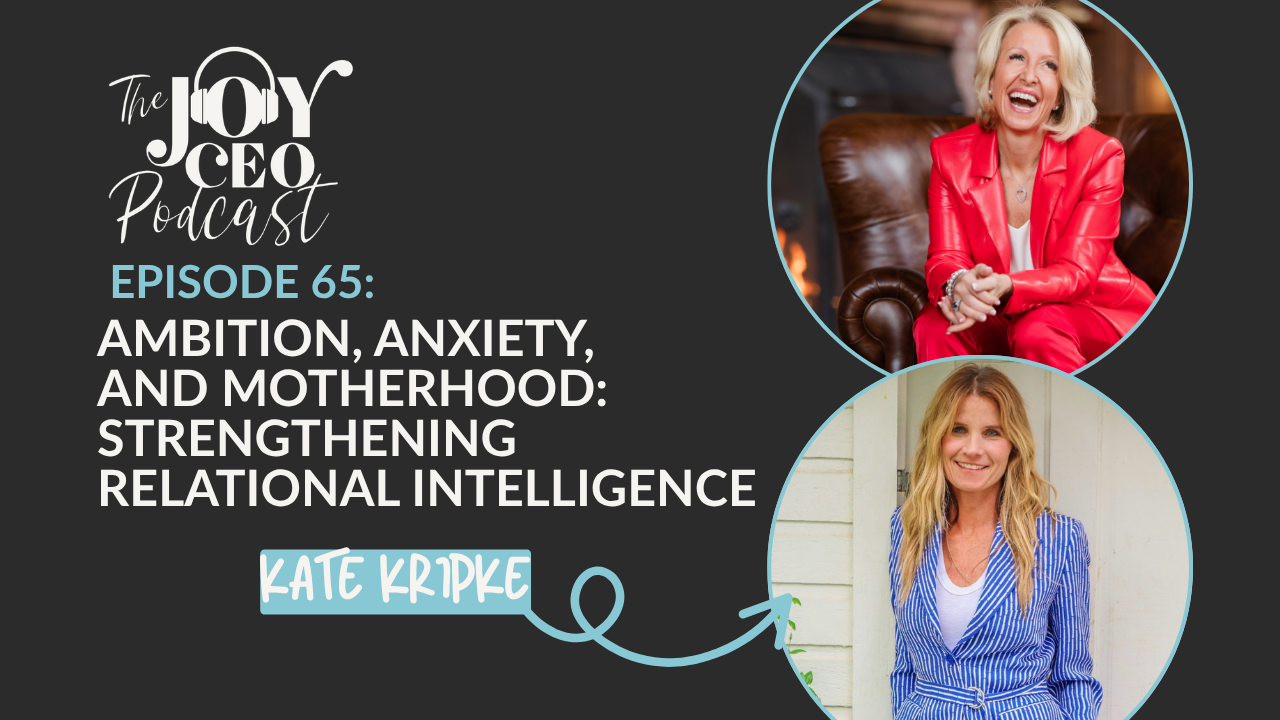
Episode 65: Ambition, Anxiety, and Motherhood: Strengthening Relational Intelligence with Kate Kripke
Aug 19, 2026In this honest and candid conversation, Lori sits down with Kate Kripke, a clinical expert who has spent more than 20 years working with mothers, to explore the relationship between ambition, anxiety, and motherhood.
Together, they unpack what happens when achievement becomes tied to self-worth, and how beliefs we learned early in life can quietly fuel the pressure to get everything right.
Kate shares her path from clinical work with teenagers and mothers to founding the Postpartum Wellness Center, now the Parent and Family Wellness Center. She explains why anxiety is a normal response to uncertainty, how children can "borrow" our nervous systems through co-regulation, and why postpartum anxiety often goes unrecognized.
The biggest shift in this conversation is moving from strategic intelligence to relational intelligence. Motherhood isn't something to solve. It's a relationship to build, and that asks something different of the part of you that's used to fixing things.
If you're a high-achieving woman, a mother, or someone who has spent years managing uncertainty by becoming more capable, this conversation is an invitation: you don't have to fix every feeling. You can learn to stay with it.
🔑 Key Takeaways
When Ambition Becomes Tied to Worth
- Ambition itself isn't the problem. The challenge begins when achievement becomes the source of identity, value, or safety.
- Learned beliefs can teach us that doing more, achieving more, or being "good enough" will protect us from discomfort.
- Audience follow-up → What do you believe achievement says about you, and who would you be without it?
Anxiety Is a Response to Uncertainty
- Kate explains anxiety as a fear-based response to unpredictability.
- Rather than something broken to eliminate, anxiety can be understood as trying to communicate something.
- Audience follow-up → Where are you trying to create certainty because uncertainty feels uncomfortable?
Our Kids Borrow Our Nervous System
- Children learn emotional safety through relationship and co-regulation.
- When we're overwhelmed, our children can pick up on it, not because we're doing something wrong, but because connection is how humans are wired.
- Audience follow-up → When your child is struggling, can you regulate yourself before you try to regulate them?
Motherhood Isn't a Problem to Fix
- High-achieving women are often exceptionally skilled at strategic thinking and problem-solving.
- Motherhood asks for a different kind of intelligence: relational intelligence.
- Audience follow-up → Notice when your instinct is to fix, explain, or solve. What would it look like to stay connected instead?
Postpartum Anxiety Can Be Hard to Recognize
- It doesn't always look like what we expect: constant worry, hypervigilance, difficulty relaxing, or a need to control what happens next.
- Lori shares part of her own postpartum experience in this conversation.
- Audience follow-up → Instead of "Am I doing motherhood right," try "How am I actually feeling?"
Relational Intelligence Means Staying With Discomfort
- Building emotional fluency means noticing feelings without immediately judging or changing them.
- The goal isn't eliminating difficult emotions. It's staying connected to yourself and others while you feel them.
- Audience follow-up → Next time discomfort shows up, pause before solving. What is this feeling asking you to notice?
A Longer Exhale Can Signal Safety
- Kate shares a simple breath practice: make your exhale longer than your inhale.
- This can help signal safety to the nervous system before you react.
- Audience follow-up → Try it. Notice what changes in your body.
🔎 Mentioned in the Episode
- Kate Kripke — clinical expert with more than 20 years working with mothers and families. (unverified, see flag above)
- Parent and Family Wellness Center — formerly the Postpartum Wellness Center, founded by Kate.
- Co-Regulation — how children develop emotional safety through connection with caregivers.
- Relational Intelligence — staying present and emotionally engaged rather than relying only on strategic problem-solving.
- Longer Exhale Breathing — a simple practice to help signal safety to the nervous system.
✨ Reflection Prompts
- Where has ambition become connected to your sense of worth?
- What are you trying to control because uncertainty feels uncomfortable?
- When do you default to fixing instead of connecting?
- What emotions do you find hardest to sit with?
- How might your relationships change if you were more comfortable with not having all the answers?
🧠 Who This Episode Is For
- High-achieving women navigating ambition and motherhood
- Mothers experiencing anxiety, overwhelm, or pressure to get everything right
- Women who struggle with uncertainty and the need to control outcomes
- Leaders and parents interested in emotional and relational intelligence
- Anyone wanting to understand anxiety through a more compassionate, nervous-system-aware lens
📩 Want to Go Deeper?
Follow Lori on LinkedIn to continue the conversation
- Book a Leadership Strategy Call with Lori: loripine.com
Find Kate Kripke on her website http://katekripke.com/ or her Instagram https://www.instagram.com/katekripke/
🎧 Subscribe to The Joy CEO Podcast
⭐️ Leave a review to help other heart-centered leaders find the show
📲 Share this episode with someone who’s navigating pressure and wants to do it with more grace
Transcript
Hello, I'm Lori Pine, the Joy CEO, and welcome to the Joy CEO podcast. I am so pleased to have the fabulous Kate Kripke with me today. Welcome, Kate. I am so glad to be here, and can I just say the Joy CEO Podcast, like, I, I don't, I don't know if people can see us. Do you do this on video as well? They do, yes.
They see us on YouTube. Because you kind of, you, like, illuminate joy. So it is a perfect name for the podcast. I love it. Yes, and you also have a podcast. I do, which you were on this week. I was. So yay. Motherhood Uncut. That's right. Yes. And your expertise, your experience, has led you to this moment where you really have become an expert for ambitious women, much like yourself, much like me-
much like all of the women who are listening [00:01:00] today, who- Yeah ... you know, really have this drive. And when I was on your podcast this week, we talked about what does ambition mean. Mm. And I told you what I thought it meant, but let me ask you, what does ambition mean to you? I think ambition to me, if I'm not being my good girl self and pulling out the dictionary to tell you exactly what it means-
I think what it means is a desire and drive to achieve great things. I agree that ambition is very similar, and I also think that it's inherent. Like, you have these levels of ambition that you really just cannot help. They just come. I would agree. Although- Mm-hmm ... although- I have learned to [00:02:00] understand, both from kind of reflecting on my own life and also, you know, I think of my 20 years of clinical work with mothers as sort of like my laboratory, right?
Mm-hmm. So in studying the women I've worked with, and also just all the research, I've come to believe that there's temperament, right? There's constitution and temperament, what are we born into this world with, and then there's learned responses. There's conditioned beliefs. There's organizing principles, right, that we develop through the way we were raised, and I mean by our, the culture in our family, what we watched or heard our parents do and say, the communities that we are raised in, the, the socioeconomic backgrounds we are raised in, the society or the belief systems of our communities that really actually lead us, many of us, who I think you and [00:03:00] I would relate to this, you know, there, there's ambitious and then there's overly ambitious, right?
Like holy crap. There's unachieving, and then there's overachieving. And when we cross over into the over land here, I think often that's because we have been taught somewhere that our worth and our value and our quote, unquote "okayness" lives in the, in excellence. It lives inside the achievement, and I think that is where we begin to see what I might just put big quotes around the word problems begin to develop.
It's not that it's problematic to have ambition. Goodness, I wouldn't trade my ambition for anything. It's not problematic to want to achieve amazing things, but when those, when that becomes a need more than a want as far as our sense of self and our identity, we do cross over into pretty problematic territory.
Yeah. When all that [00:04:00] ambition equals our self-worth- 100%. Dangerous territory. Absolutely. That's right So a little bit about you, and of course I'll do the full bio, but tell us a little bit about this 20-year, quote-unquote, laboratory that you're referring to, and how you got to this moment. Yeah. Well, maybe I'll back up and tell you a little bit about how I became, became me, and I promise I'll do this in three minutes or less.
But it really does, has influenced this, my, my draw towards this quote-unquote laboratory, my clinical work. But I was raised in New York City, as you know so well. Mm-hmm. Yes, yes. By, by two- Very perfectionist, high achieving parents. They were both lawyers, so they were both kind of incorpor- uh, you know, in sort of corporate type of an industry, right?
Although [00:05:00] my mom went a little bit of a different direction than my dad. My dad was a trial lawyer, a criminal defense attorney. My mom started in corporate law, but then went towards kind of family law, and ultimately was a leader and a, an idea generator in the field of arbitration and mediation, which of course is now a big part of what we know incorporates that whole concept of law.
But she was like a glass ceiling breaker and a trailblazer. Both my parents were q- quite anxious themselves, meaning that they sort of needed this sense of external validation to feel good enough. It showed up differently for both of them. We won't go into that right now, but I do think it's worth saying that I grew up in a very privileged background with a lot of emphasis on education and sports and achievement and appearance and all these things that, you know, neither of my parents ever said, "Your [00:06:00] worth is tied up to your appearance," or, "Your worth is tied up to your a- awards," but it was in a little bit modeled just by the way they functioned in their own lives.
Does that make sense? Yeah. Yes. And again, not all bad, you know? I had, like, a great education. I did amazing things in my life, and I would say that I grew up with a lot of anxiety. I had m- a lot of panic attacks as a kid. Took me a long time to sort of dive in through my own therapy work and my own kind of self-discovery to figure out what was mine and what was theirs, but ultimately I realized that, okay, I ha- a lot of the anxiety that motivates me to do amazing things is actually not my anxiety.
Does that make sense? It's- Yeah ... being, it, it was inherited through this culture that I was raised in, and that became a real motivator for me in the work that I do and did. I, you know, started my [00:07:00] career ult- in the very beginning, I should say, I wanted to I thought I wanted to work with teens, and I wanted to work with teen girls and be sort of this, of course, true to form, I wanted to be, like, the expert in adolescent girls.
It wasn't just that I wanted- Yes ... to work with, I wanted to be, like, the go-to person. Mm-hmm. Mm-hmm. Save them, help them. Ugh, save them, help them. And of course- The, the, the teenage girls were not the ones that wanted to be in my office, but their mothers did, you know? I, I branched out of, of just girls and moved into this sort of field of adolescence, and I was like, oh, those adolescents weren't the ones that were wanting to get support.
It was the parents that did, the mothers that did. And that really became curious to me because, of course, my ultimate goal was to make sure that these, you know, I guess we, we used to call in grad school, we used to call this a methis. Have you heard of that, methis- No ... instead of a thesis? We had to write a thesis in grad school.
And everyone would write their methis, right? We'd study the thing that we could most relate to. [00:08:00] And, and I did not want these kids to grow up having panic attacks. I did not want these kids to grow up feeling like they weren't good enough and that they had to prove their worthiness. Yeah. And I learned very quickly that that inherent drive that comes from I don't think I'm enough is actually learned.
Wonderful. And if we could teach mothers, if I could work with the mothers when their babies were little to learn how to approach motherhood differently, to approach the transition from single, driven woman to mother in a way which we all know is, like, a psychic trauma - Oh my gosh ... in a- right? If I could help them do that in a way that helped them actually learn from what motherhood asks of us rather than reject it, because it can feel really scary for those of us that don't like to slow down and don't like to feel our feelings and don't like to not know the answer, if I could support moms in that [00:09:00] early stage to, to transition in a different way where they actually were growing instead of feeling like they were losing themselves and, and always fear-based, then I was not only doing the mom, that mom a service, but I was doing their children a service.
Yeah. So I, so I established a, a center here in Colorado, the Postpartum Wellness Center, that is now the Parent and Family Wellness Center. I ran that center for 15 years, and then I, as you know, kind of made a little bit of a turn to do more speaking and teaching and mentoring and coaching, more away from the clinical work and more into this other work that I do now.
But I do consider the, the 20 years that I was doing that more clinical-based work as a laboratory because themes emerged. And while I'm not a psychologist that focuses on research, I was gathering evidence and seeing trends and connecting dots through all of that work. Okay, there's so much to unpack in everything you just said, so [00:10:00] I have a, a couple of things to go back to.
You said that you were carrying anxiety that was not yours. Yeah. The anxiety wasn't mine. Yep. Holy smokes. How many of us are carrying anxiety that is not ours? Yes. I obviously don't have... What a question. That is, like, sort of the q- that is the question that fuels my work. It also- Mm ... is the question that fuels the curiosity around my work, which is how do we not do that, right?
Mm-hmm. So let's back way up and say if we're, if we're really, really gonna break down, like, what is anxiety, right? Mm. It's this word we th- we throw it around clinically, we throw it around social media, we throw it around, like, you know, in, in flippantly, in, like, jokey ways. Like, it is this term that both has stigma and has actually lost its meaning a little bit.
Mm-hmm. So [00:11:00] anxiety is a fear-based response to something. Our nervous system's only job is to keep us safe. That's it. And our nervous system, meaning our physiology, meaning our body, does not know the difference between real and perceived threat, okay? What is inherently a threat to human beings, like, our- we're hardwired to see if this is a threat, is uncertainty and unpredictability.
Hardwired, okay? That means if I am in a moment, if Kate Kripke is in a moment of uncertainty or unpredictability, if I'm about to get up on stage and give a keynote talk, and I have no idea how the audience is gonna respond, I will feel anxious, right? If my teenage daughter is getting in a car and driving five hours with eight friends to go to a concert for the weekend, and I have...
There's s- s- [00:12:00] so much unpredictability and uncertainty, guess what I'm gonna feel? Terrified. Yes. Anxious. Terrified might be slipping over into something else, so maybe at some point we can talk about the difference between those two things, right? Okay. Anx- If I have a new, if I have a new baby and my baby's crying and I don't know why, what am I gonna feel?
Okay, all of this is to say that anxiety is actually a normal human response to uncertainty and unpredictability, okay? Yes. If I am... So life has many moments where we're going to feel anxious. I don't wanna demonize anxiety e- ever. I think we can look at anxiety and be like, "Oh, I'm feeling anxious. That's bad.
I have to fix this feeling. Am I gonna take medicine? Am I gonna stuff it? Am I gonna pick up the bottle of booze? Am I gonna get on my phone and scroll? Like, am I..." We treat anxiety as something we have to fix, when really it is just this normal human response. And if I don't know how to take care of myself [00:13:00] around my own anxiety, I am likely to carry that with me into every relationship I'm in, and I'm likely to do this thing that all humans do.
If I can't take 100% responsibility for my anxiety, and be compassionate about it, and understand it, and know how to take care of myself around it, I am going to put it onto you, right? Hmm. I'm gonna need you to act a certain way so that I don't feel anxious. I'm gonna, without even realizing it, make you responsible for my anxiety.
This is what a lot of parents do without realizing that it's happening. And I said to myself when I had two daughters, and I had horrible postpartum anxiety after my first, who's now 19. When I had my two daughters and I finally came out of this, like, "I have got to change something," I was like, "I will be successful as a parent if I can manage and take care of my own anxiety so that my daughters don't have to manage and take care of my own anxiety.
[00:14:00] If I can make space for my daughters to have their own anxiety, because what human isn't gonna feel it, and not add mine to their plate, then I have been successful." Does any of that answer your question? All, all of that resonates. Now I have more questions. Great. First one, how would you do that? How would you make space for your anxieties so that your daughters aren't responsible for your anxiety and have room for their own?
How do you do that in a healthy way? Okay, well, this is a huge question, so I wanna break it down first. Because if it were- Easy, we'd all be doing it We'd all be doing it. 'Cause I don't think anyone listening to this conversation wants their children to have the burden- No ... of their anxiety, right? No. I think you're actually speaking to something that is a pretty universal deme- dilemma for really smart women, right?
Yeah. High-achieving smart women, [00:15:00] which is I know what I want to do, but I can't seem to do it. Why? I have all this information. I know that, you know, many people have know this, but I'll kind of put it in our pot right now, our children borrow our nervous system. They borrow a nervous system from us. This is called co-regulation, right?
If I'm trying to get a child to sleep, and I go into that room really tight and tense and anxious that they won't sleep, I am actually s- giving that to my child. So I can't expect my child's nervous system to settle enough to go to sleep if I'm tight and tense. I can say all the right things. I can follow all the sleep advice.
It won't work, right? 'Cause our children borrow our nervous system. Yeah. Okay. Right. Same if I drop off my kid at daycare to go to work or with a babysitter. If I'm, like, tight and tense and feeling guilty and anxious, what do you think's my kid's gonna feel when I do that? Same thing. Anxious. Yeah. Right.
Crying. Yeah. Mm-hmm. Exactly. So, so I think we know on some level, we read the books, [00:16:00] we listen to the podcasts, we understand things to a certain a- a- you know, kind of academical, intellectual level, and yet we can't help but snap at our kid when they're taking too long to put on their shoes, right? Right. We can't help but start to get anxious and tense and tight when our kid is crying, okay?
So then we're like, "Okay, I wanna be more present," which is something I hear all the time. "I wanna be more patient. I don't wanna be distracted all the time. I know those things are, quote-unquote, n- bad or not good for my kid or our relationship. Why do I keep doing it?" The answer is because our nervous system doesn't know the difference between real and perceived threat.
Our nervous system doesn't learn through information, it learns through experience. So if I was taught that uncomfortable emotions are bad, that feeling sadness, disappointment, frustration, anger, whatever it is, is bad or means that there's a problem, if I believe that not knowing the answer to something is bad and a problem, if [00:17:00] I believe that, that someone else struggling and having a hard time is a reflection of me and a problem, then my nervous system will not let me do the things I want to do.
So how do we do that? We have to teach our nervous system something different. Yeah. And teaching isn't just through knowledge, you know? You're ... Some people are gonna come off this conversation and be like, "Oh, that all makes sense. I'm gonna start doing that today." And guess what? You might be able to do it a little more today, but tomorrow you're gonna be right back to where you were, because our nervous system doesn't care what we know up here.
It cares what our experience has told us and shown us in our childhood, and also over and over and over. Time and time and time again. That's right. So something else you said that I wanna go back to is, and kind of normalize, is that we all wanna slow down. We all sort of stuff our feelings. You know, you spoke that we kinda wanna [00:18:00] feel our feelings, but we f- we stuff them because that's what we do.
We, we don't have time for those feelings. And then we, we wanna show up in our life, but we're really not. So I, I just wanted to repeat that back because I wanted to normalize that, that this is happening to, to so many more of us than we probably even realize, that we are doing these things, rushing through life, stuffing our feelings, and not showing up.
Yeah. I think our culture, and I mean American culture, kind of capitalist American, you know- Yeah ... patriarchal culture. Yes. Right? I, I think it rewards speeding up, getting more done, efficiency, optimization, achievement, success. It rewards those things. It does not reward slowing down, feeling emotional discomfort, living in uncertainty.
Yeah. So w- we grow up [00:19:00] strengthening what I call strategic intelligence, this intelligence that is based on fixing, problem-solving, planning, again, optimizing, controlling. We grow up strengthening that kind of intelligence, and we don't grow up with time and focus and attention on strengthening what I call relational intelligence.
And we can get more into these words if you want to, but relational intelligence is the wisdom to stay. And what requires staying is being willing to feel emotional discomfort, being willing to slow down- Being willing to not know the answer, being willing to be wrong. These are things that are not celebrated and highlighted in our culture.
These are the things that are required for being present with someone. Yeah. So when I hear people say, "I just wanna be present with more, more present with my child," what they're actually saying, without realizing it, is, "I just wanna know how [00:20:00] to feel the uncomfortable feelings without having to fix or run away or dismiss or hide or put it down.
I just wanna know how to sit in uncertainty and not have to find the answer." Yeah. "I just wanna know how to slow down and not speed up because... And, and not sort of react or, or kind of act on that internal urgent feeling to get up and go do something." Because in order to be present, we have to stay, we have to be right here with the reality of the moment.
And you and I both know, the reality of the moment in life, but especially in parenting, does not always feel good. No, no. Parenting has been the hardest thing I've ever done. Hardest. I think most, most people in my ex- in my laboratory- Yes ... of 20 years of experience, and by the way, let me be clear, the women in my office for 20 years are not necessarily the women that people might expect.
They're the women who you and I see walking down the street who look like they have it all together, right? Oh, yes. They're the professionals, they're the [00:21:00] creators, they're the athletes, they're... They're, they're my subjects, right? Yeah. They would all say the same thing. I had a woman on my podcast this month, this is sort of a crazy story, but she was na- international news, kidnapped by Somali pirates in her 30s- Oh my gosh
and held in captivity for 90 days. Oh my gosh. She said that becoming a mother was harder than that. Holy smokes. So yes, parenting, hardest job ever. Hardest job ever. Yes. Yes, rocked my world. Now, I want to get back to one more thing that you said, and it's this idea that we have postpartum I would have told you, and I think I did when I met you, I didn't have postpartum.
Mm-hmm. Because in my mind, postpartum looks a certain way. How does it look in your mind? You're [00:22:00] unstable. You, you can't show up. Y- you're quote, unquote crazy. Maybe you do something drastic. Maybe you can't get out of bed. Maybe you harm your child. Maybe you harm yourself. Like, it's, it's the extreme. Um, uh, thank you media- Yes
for sending all of those images into our head. Right. Right? Right. That's right. Uh-huh. So I would have told you, "No, Kate, I didn't have any postpartum." Yeah. 24 years ago when my first child was born. What was your son- But after talk- I was fine. I was fine. Okay. But after talking to you, I'm like, "Kate, where were you 24 years ago?
I really could have..." Right? So let's talk about postpartum. Yeah, let's talk about it, but can I ask you a question first? Please. What are you hearing me say today that resonates most with what your experience was in that first year after having your son? One, that it was the hardest experience and the hardest time of my life.
Why? [00:23:00] What, what ca- what, what was the... What's your definition of hardest time of my life? What... Explain that to me. There was so much uncertainty. I mean, not that I'd ever been captured by Somali pirates, but I'll get up and speak to 5,000 or 10,000 people, no problem. But this baby- I hear this all, I hear, I hear this all the time
this baby, oh my gosh, I, I didn't know what to do. I, I, I, I, I was rocked, and- I didn't think I had the answer within me. Like, the anxiety was so high, I didn't trust myself. When you say anxiety was so high, when you use that word and that description, can you give that some quality for us? What do you mean by that?
Yeah, and I can only use that language coming from the rear view mirror. Yeah. At the time, I probably couldn't have even used that language. But [00:24:00] I was dysregulated. I was disassociated. Yeah. I, I was very reactive. He cried, I jumped. Yes. In fact, funny story, my mother came and stayed for two months, and sh- one night she said, "Why don't you two go out to dinner?
You could use some fresh air." And, and I said, "I will only do that if you promise you won't put the baby down." "You will hold the baby the entire time I am away." I mean, I was just, like, out of my mind. Mm-hmm. Yeah, okay. So what I just heard you say, if we just cut it down, like without all the ex- explaining things, you said there was so much uncertainty.
I didn't think I had the answer within me. I was dysregulated, dissociative, dissociated, reactive. I couldn't tolerate... You said to your, you wa- you wanted your mother-in-law to be with the baby if she didn't put your [00:25:00] baby down, which to me says you can't tolerate the idea of your baby's distress. Not at all.
Okay. Okay. So in rear view mirror, in retrospect, what does this tell you about your nervous system? What does your nervous system believe is safe, and what does your nervous system believe is dangerous? I don't know that anything was safe at that time. I think everything was dangerous. Well, you're ta- well, what would be safe is certainty- Yes, yes
knowing and having all the answers- Mm-hmm ... and a baby that was never distressed. Right, and being able to self-refer and figure it out myself. And being able to not need help and figure it all out- No ... all yourself. That is what safety is. Yes. Okay. And if someone was li- what do we know to be true about motherhood?
There's no map. It doesn't come with a map. There's no manual. Nothing's ever predictable. We're never gonna know. Right. All of that is just true. It's [00:26:00] inherent in motherhood. There's no one right way to rai- raise a child. Yeah. None. I, I don't care who out there says, "This is right and this is wrong," I'm telling you right now, it's all contextual.
There is no one right way to raise a child. There is so much uncertainty and unpredictability, 'cause these little humans can't tell us what they're feeling or thinking, right? Mm-hmm. And if we've never done this before, although I will say I think this happens for many second and third time parents as well, how would we know the answer?
We're beginners, okay? Right. So everything that comes with motherhood, your nervous system believed was dangerous. Yes. That is the definition of postpartum anxiety. Mm. That's it. Okay? Mm-hmm. What does it look like? It can look like difficulty making decisions. It can look like irritability, and like this chronic underlying agitation that can come out in sort of these small things.
It can look like trying to control everything around us, [00:27:00] micromanaging. It can look like busy monkey brains, so every time we g- lie down to go to sleep, our thoughts jump up. It can look like catastrophic thinking. It can look like rigid, all or nothing thinking. It can look like over-researching, look, r- reassurance-seeking.
All these things that on the one hand, some of us have decided is just normal, right? Mm-hmm. Like, how many people are like, "Ugh, you'll be fine once your baby gets o- older," right? "Oh, it's just every mom is up at night spinning," right? So we've sort of over-normalized some of that, right? Mm-hmm. And we've also learned to just say, "Oh, I'm not anxious.
I don't have postpartum. I'm just busy. I'm just overwhelmed." Yes. Right? And, and busy and overwhelmed can be synonymous for us high and overachievers as productive, right? Very. I'm doing so much that I'm busy and overwhelmed, but these are sort of like words to celebrate. So now in retrospect, [00:28:00] what do you imagine, either from our conversations or just from all of your wisdom and knowledge as you've raised your kids and done your own work, how do you imagine this state for a mother might impact her child?
Oh, you know, without, you know, her knowing it, would certainly impact her child, you know, in a way that they're feeling that same anxiety, that same nervousness, that same discomfort. And so they're wondering, where's the danger? Where's the, you know, uneasiness? That's exactly right, and I love what you said without knowing it, because we have to approach these conversations with, like, truckloads of self-compassion and not shame and blame, because- Yes
this woman you and I are talking about, which you and I categorize as, if we knew what to do, we would be fucking doing it. And not only if we knew- Of course ... what to do, but if our nervous system allowed [00:29:00] us. So we're gonna come back to that in a moment, right? But the reality is that our, our babies and young children literally borrow a nervous system from us.
So if our nervous system is being hijacked in a chronic state of danger, danger, danger, right? It ki- kind of a- we might call it agitation. We might call it tension and tightness in our body. We might call it overwhelm or busy- busyness. If we don't know how to come down from that, our babies' and young children's nervous system is developing around that way of being.
So many kids with moms who are stuck in this will have a hard time sleeping. They will be, have a hard time eating or breastfeeding or, you know, feeding, so to speak. They will be, have, quote-unquote, "behavioral challenges." They'll have a harder time learning. They will have a harder time making friends. They will...
All these things, all behavior is ref- is a [00:30:00] reflection of feeling, right? All of these behaviors are what we see in kids when they don't feel safe, and this doesn't mean there's abuse in the home. I want to be so clear. Like, let me use myself as an example. Of course. Right? Like, my parents adored me. They gave me everything they possibly could.
I was one of... I, I'm really lucky that I didn't have any big T trauma in my life growing up. Yeah. But I, my nervous system did not feel safe. Yeah. I constantly felt like a shoe was gonna drop. So what's a girl to do? What's a girl to do? So there's some- right, there's somebody out there listening. Yeah. She's got a, a young child.
She i- is listening to this and she resonates. Yeah. What does she do? Yeah. Well, first she pauses and reflects because I think many of us, m- maybe you and I from a previous generation, you know, y- you and I have, you know, adult-ish kids. Your boys are a little lo- older than mine, but sort of, you know, it [00:31:00] was, been 20 years since, you know, we were raising kids.
I do think there's more conversation now about postpartum than there was. There's more opportunity to pause and reflect. So the first question we need to ask ourselves is how do I feel? Not what am I doing or not doing, but how do I feel, and do I want to continue to feel this way? And if the answer is yes, then there's nothing to do.
Okay? Then we're like, let, then let's just give you so- your permission to just do what you're doing, 'cause you get to create your own life. If the answer is, I do not feel good, and whatever version of that is, and no, I don't want to continue to feel this way, then we wanna pause and say, okay, so let's sort of back up for a moment and recognize that motherhood is probably the first time in your life that you have learned or been asked to pay attention to the fact that the strategic intelligence does not cut it.
Because the more we try to fix and plan and [00:32:00] problem solve and optimize in motherhood- Ugh ... the more crappy we feel. Yeah. The farther away we get. Isn't that the truth? Yeah. My strategic planning for motherhood failed. It doesn't work, and it's confu- let's like to, it's very confusing for us because it's worked everywhere else.
Yes. It's worked everywhere else. But motherhood is not a project to solve, it's a relationship to build. Mm-hmm. Which means we have to strengthen our relational intelligence. And let me just pause for a moment, because a lot of people hear this and they're like But I have relationships, and I have good friends, and I have a husband.
For many of us, if we really get honest with ourselves, which is so vulnerable and hard to do, we will realize that there was str- strategy in all of that, right? I have good friends- Gu- guilty. Yeah, exactly. Guilty. Yeah. I have good friends, but I'm also the people pleaser. Oh. In my good friends, I'm [00:33:00] always taking care of everybody, right?
Yes, yes. Right? Or I have all these colleagues, but I've been building colleagues to, you know, get, get ahead in my career. Yeah. Or I have this husband, but I had the husband because on paper when I was a kid, I was like, "I'm gonna have a husband, I'm gonna have a house." So again, we just wanna sort of understand the difference between strategy and relationship.
Yeah. And to strengthen relational intelligence, we have to begin to be open to the possibility that uncomfortable emotions are not a problem, first and foremost. Yeah. That everything we feel makes sense, because most of us will get a hint of disappointment or frustration or anger or fear or guilt, and we'll jump into that strategic brain and try to fix our way out of that, or distract our way out of that, right?
Or with our kids, the moment our kid comes home and they're sad because something happened at school, we are like, you know, s- you know, so and so didn't sit with our kid at lunch, and we're like, [00:34:00] "Oh, don't worry about it, you've got other friends." Right. Fix, fix, fix. Or we're like, "Here's a lollipop," right? So it, so it's, it's, we think we're doing our child a favor, favor, but really what builds relationships is when our children and we feel completely seen, heard, and understood and accepted for who we are at our core, not for what we've done, not for who our friends are, not for how happy we are, not for how well we're doing, doing- Yeah
but for who we are. And guess what? Humans feel emotions. So we have to learn how to allow for that uncomfortable emotional experience without sh- jumping ship. That's probably the first and most important thing we need to learn how to do, and I can give you a little practice for that if you want. Please, yes, let's do it.
Before I do that question, I have que- two, question is two parts: how does that feel to you today to hear me say that, and how do you think that might have felt to you when you were a young [00:35:00] mother, if I were to say that? So today, I am relatively comfortable with it because I've had some practice. Yeah.
When I left my corporate job, I became a stay-at-home mom, I, I did get some practice in this department. Yeah. When I was a young mother, I likely would've been very uncomfortable. Mm-hmm. I, I didn't know how to do this. Right. So I think it's important to recognize that and to remember, you know, a big part of the work I do with women in the very beginning is helping them uncover what their kind of, you know, inherent conditioned beliefs are about some of these things.
What were you taught about uncomfortable emotion when you were growing up? And again, t- the question is directly or indirectly. You may have had a parent who every time you cried smacked you. Okay, that's messaging. Yeah. You may have had a c- a parent who every time you cried didn't do anything 'cause they [00:36:00] were a single parent with three jobs, and they didn't have time.
That, that is actually messaging, not because your parent's doing something wrong, but because you're kind of learning that, uh, that, you know, kids are gonna learn very quickly, "I'm not gonna get what I need, so I might as well stuff this thing," right? Or you may have had a parent who every time you felt emotional discomfort swooped in to fix or maybe even snowplowed so that you would never feel emotional discomfort.
This is all messaging. So if someone's raising their hand during this conversation, it's a really important question to ask because we have to begin to be open to the possibility that this thing that we learned when we were young is not a fact. We have to open up room in our nervous system for something different.
Does that make sense? It makes sense. So back then, if I had said to you with a little child, "Okay, Lori, well, here's the deal. W- we're actually have to sit with your fear and anxiety and disappointment. We have to f- actually feel it. We [00:37:00] can't, we can't do something to not feel it," you would've been like, "Nope, can I...
No fucking way." No, no. Your nervous system would've rejected everything about that. So- Yes ... we have to start with sort of the inherent operating system. Yeah? Mm-hmm. That make sense? Yes. Okay. Yes. Once we've opened up to the possibility that feeling emotional discomfort is not a problem, we need to begin to train our nervous system, and there is a breath.
I kind of think this less as breath practice and more as a conversation with our nervous system, but there is a breath that actually immediate let, immediately lets our nervous system know that there's no danger, and this is a breath where our exhale is just a little bit longer than our inhale. So if I'm breathing in for three, I breathe out for four.
I will tell you, Lori, that I've taught myself to breathe this way all the time. And this has literally changed my relationship to emotional discomfort. So if I'm feeling disappointment, let's say you [00:38:00] and I have this plan to do this podcast, and I'm really excited about it, and you call, not that you would do this, but you call and you're like, "Kate, I've decided that you're probably not the right fit for my podcast, so I'm gonna cancel this and go a different direction."
If I'm a healthy individual, I'm going to feel disappointed. Mm-hmm. No problem. That is not a problem. That is a normal human response. If I let myself feel the disappointment, the tightness in my chest, the turning in my belly, not feeding the thoughts, "Lori doesn't like me. I'm horrible. I'm never gonna succeed in life," that's thinking.
So not the thoughts, but if I let my body feel the feeling and I breathe like that- Mm ... I'm teaching my s- nervous system that I can feel this feeling and still be okay Technically, that longer exhale is what flips the switch, because when we're in a real threat, we're taking in more oxygen than we're letting out because our muscles actually need the oxygen to fight or run.
So by breathing out more than we're breathing in, [00:39:00] we're literally saying to our nervous system, "There's no threat here. I can feel this, and I can still be okay." Amazing. See, that- Simple practice ... simple practice, and think about that. If you believed, if every mother out there, every corporate CEO, every entrepreneur, every pro athlete, every mother, every everybody believed that they could feel emotional discomfort- Yes
and still be okay, what might they have access to that would be different? Joy. Joy, time. Yes. Connection. Potential. Connection. Yes. Presence. Yes. And when I learn that myself as the mother in this dyad with my child, remember my child borrows my nervous system, now when my child feels really disappointed because I was working during their soccer game- Mm
and I chose to have this meeting instead of being at their soccer game, or I'm like, "No, you can't have that piece of cake," right? And they feel [00:40:00] disappointment, or they feel anger, or they feel sadness, and I trust that I can feel those things and still be okay, what message am I sending my kid? That they can feel it and be okay.
And I'm more likely to say, "Of course. Of course you're bummed and mad at me that I wasn't at your soccer game. That makes so much sense to me." And when my child gets that messaging, what happens to my child's nervous system? Whew. They can- It settles ... they can regulate, yes. Exactly right. Not just because they're borrowing my nervous system, but because what our children need to feel safe is to feel seen, heard, and understood.
So that connection, that simple act of seeing them settles their nervous system. The tantrums get shorter and s- and smaller, right? The, the wild behavior takes on a different tone to it. Mm. Doesn't mean our kids are not gonna still feel bummed that we weren't at the soccer game or that we said no to something.
Of course they do, but the length of energy [00:41:00] that it takes them to make sure we understand that goes way down Yes. Wow. So powerful. So powerful. I think, you know, this connects to so many women that I work with, so many women that have been in my world, women I've managed, women I've walked alongside with, and certainly for myself.
Hon- me too. I mean, tell me about it. Let me be real clear. There is nothing I just talked about that I'm not practicing on a daily basis. I mean, you know this, little kids, little problems, big kids, big problems. So just because our kids are teenagers doesn't mean that the uncertainty and unpredictability and emotional discomfort lessens, right?
No. The stakes actually raise. So yes, for sure Kate, any last thoughts for the woman out there who's listening and, you know, she's like, "Wow, this really hit home." I think I wanna reiterate something that I said in [00:42:00] passing at the very beginning, which is that wanting to achieve, wanting to be excellent at what we do, having goals, this strategic intelligence is not a villain.
No. It's amazing. We do not need to lessen the strategic intelligence we have. And if that's all we know how to deflect to and defer to, that's where the problem happens. So we need to strengthen these other skills, this other intelligence, so that we know what the moment calls for. Yes. Right? In this moment, w- who do I wanna be?
What does this moment require? What does this relational interaction require from me? Does it require that I go into problem-solving and fixing and strategizing, or does it require that I go into feeling and staying steady, being willing to not know the answer, curiosity, right? So that we can move between the two.
That's really what [00:43:00] I call fluency, and when we become fluent between those two, we flourish in our relationships. We flourish in our jobs. So I guess that's the final added cherry on top is that I don't believe we have to choose as women. Am I gonna be a CEO or an entrepreneur or a professional athlete, or am I gonna be a devoted mother?
We do not have to choose, but we have to strengthen- Yes ... this relational piece so that we can move between the two so that we can form those really healthy, secure relationships with our kids while we do this other kind of purpose-driven stuff outside of our mothering life that's so important to us. Yes.
I agree. Amen. We, we can do it both, but we have to have the right tools in the toolbox to do it. That's it. And you are certainly bringing those tools. I know I've referred a very lovely client of mine to you- You have ... because you do such great work. So tell everyone what sort of work you do and where they can find you.
Yeah. [00:44:00] So I exclusively coach am- ambitious, high-achieving- ... women who, who want to work and be on a career path. I wanna make it really clear, I, if people do not want to have a job outside of motherhood, if their heart and soul sings to being home with their child- Hallelujah. This is not a what's better, what's worse, worse.
But really the people I work with are the people who know that being a stay-at-home parent is not for them, for whatever reason. Maybe they have to work. Maybe they just know that there's something else inside of them that they wanna f- kind of flourish in. Okay, so I have, I have a, a, a two-week coaching program.
I have a 12-week coaching program. People can find more out about that on my website, katekripy.com, Instagram @katekripy, and yeah, my podcast is Motherhood Uncut. And we will link all of that in the show notes and help everybody find their way to you, because I know that you are really making a [00:45:00] difference in the world, Kate Kripy.
Aw, thank you, Lori. I- Yes ... adore you. As I said in my podcast last week, like, why aren't I sitting next to you with a cup of tea right now? We're gonna make that happen- We're gonna make it happen ... in 2027, for sure. We are. We are. So yes. Yes. Kate, it was a pleasure to have you on today. Thank you so much. With all the joy I have, you are a treasure.
Thank you, Lori. I'm feeling joyful as we- Yeah ... wrap up our conversation today. Yes. Thanks for listening to The Joy CEO. I hope today's conversation left you feeling seen, stretched, and a little more grounded in your own joy. If something resonated, be sure to hit subscribe, leave a five-star review, and share this episode with someone walking a similar path.
And if you're ready to take this work deeper, connect with me on LinkedIn or Instagram @loripaine, or head over to my website, loripaine.com, to learn more about coaching, retreats, and how we can work together. Because joy isn't just personal, it's [00:46:00] powerful. And when you lead with joy, you don't just rise, you bring others with you.
Until next time, keep leading with heart, and don't forget to claim your joy.
