
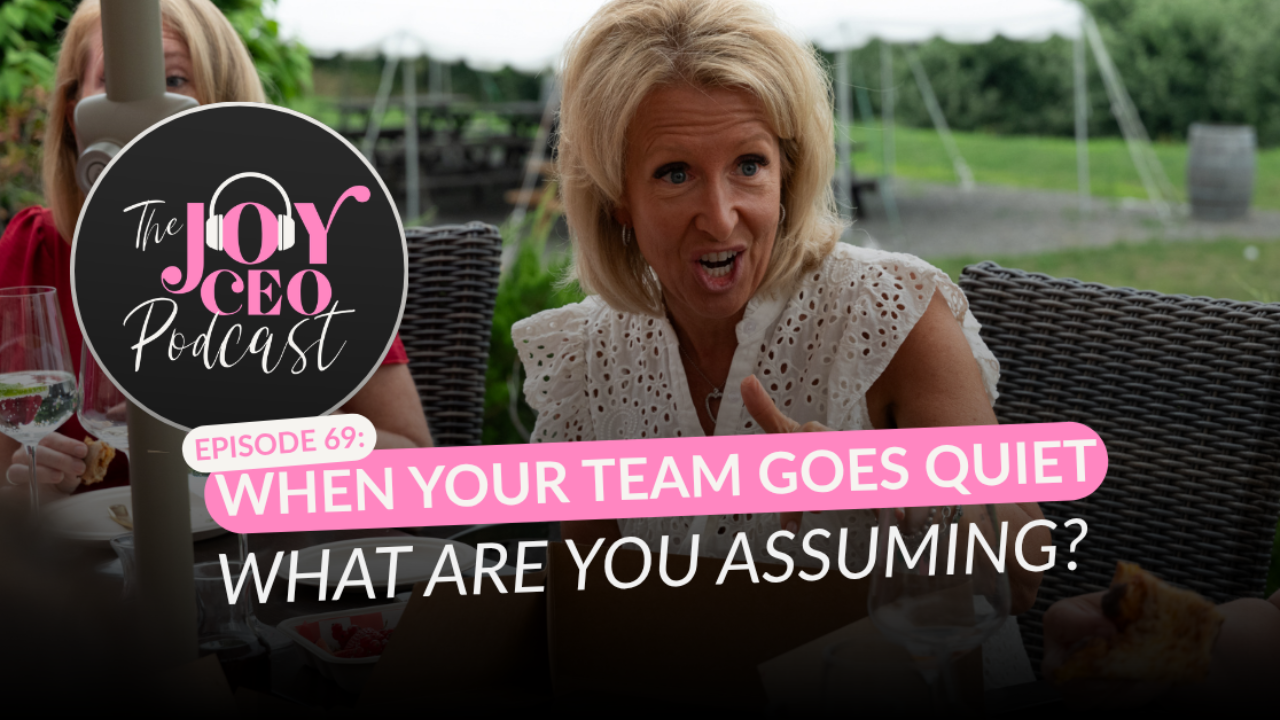
Episode 69: When Your Team Goes Quiet: What Are You Assuming?
Sep 15, 2026What if the people around you aren't disengaged, careless, or pulling away? Specifically, what if the people who work for you are actually doing their absolute best? In this episode, I'm talking about the power of positive intent and how simply changing the story we tell ourselves about other people can completely change the way we lead.
I share a conversation with a CEO client who noticed that when budgets and timelines got tight, his anxiety would kick in and he would become more reactive and start micromanaging. The problem was that he was interpreting short replies and lack of response from his team as apathy, when in reality, they were heads down doing the very work he was so worried about.
Positive intent isn't about being naive or ignoring problems. It's about starting from the belief that the people you hired, your team, your partner, your friends, and the people you love are likely trying to do their very best.
3 Key Takeaways
- Your assumptions shape how you lead.
When pressure rises, it’s easy to interpret silence, short replies, or delays as a lack of investment. But the story you create in your head may not be the truth. - Positive intent can interrupt the cycle of reactivity and micromanagement.
When you trust that your people are trying to do good work, you create space for them to work from motivation rather than fear of your reaction. - Pause before creating a story about someone else.
The next time someone goes quiet or their response feels short, ask: What would I assume if I believed this person had positive intent and was doing their absolute best right now?
🔎 Mentioned in the Episode:
-
Positive Intent – The leadership practice of assuming that the people around you are showing up with good intentions and doing their best.
-
The CEO Client Story – A client noticed that pressure around budgets and timelines caused him to become reactive and micromanage his team.
-
Motivation vs. Fear – The difference between having a team that works from motivation and one that works out of fear of their leader’s reaction.
-
The Story We Create – How short replies, silence, or unanswered messages can lead us to make assumptions that may not reflect what is actually happening.
✨ Reflection Prompts:
-
Where have you assumed someone stopped caring when they might simply be overwhelmed or focused on solving a problem?
-
What story are you creating about someone based on their silence or a short response?
-
What would you assume about this person if you believed they had positive intent and were doing their absolute best right now?
🧠 Who This Episode Is For:
-
CEOs, executives, and leaders managing teams
-
Managers who find themselves becoming reactive or micromanaging under pressure
-
Leaders who want to build teams motivated by trust rather than fear
-
Anyone looking to communicate and lead with more awareness, curiosity, and joy
📩 Want to Go Deeper?
Follow Lori on LinkedIn to continue the conversation
- Book a Leadership Strategy Call with Lori: loripine.com
🎧 Subscribe to The Joy CEO Podcast
⭐️ Leave a review to help other heart-centered leaders find the show
📲 Share this episode with someone who’s navigating pressure and wants to do it with more grace
Transcript
Hello, and welcome to the Joy CEO Podcast. I'm your host, Lori Pine. Welcome to the show today. I wanna ask you, imagine someone wraps up a long day. They sit down for dinner, they pull out their phone, and they show their family a picture of a project that they've been working on. They're so involved in this project that they want to make sure that they show it to the people they love the most.
Now, tell me, why would they do that? Well, because they're proud of it. They're proud of the work that they do, the way that they show up in their day jobs, whether it's 9:00 to 5:00, 11:00 to 7:00, whatever it is. So I ask you To now picture their boss. Imagine that boss, CEO, supervisor, whoever it might be, is all the way across town, convinced that [00:01:00] that very same person has checked out, isn't doing the job to the best of their ability, and likely they need to find somebody else to fill that spot.
Do you see the disconnect? If this is your first time here, welcome to the show. This is a show for ambitious women who want to lead and live with joy. We wanna make sure that this is the kind of joy that actually fuels your leadership, not just the fluffy rainbows and unicorn kinda joy. So this is what I teach.
Stick around, because this story actually gets juicy. If you are new here, welcome. I'm so glad to have you. If you are back here again, again, welcome back. You know I love you and appreciate the fact that you keep showing up with me. If you were with me last week, we talked about how fast we are to judge other people, and what that first [00:02:00] impression can actually cost us.
This week, we are going to go one layer further, not just how we judge, but a specific belief that can completely change how you lead when things get tense. What I wanna talk to you about today specifically is the idea of positive intent. Imagine that you actually believed that everyone who worked with you and for you had positive intent.
It could be a game-changer. So a CEO client of mine sent me a text this week and was really seeking feedback. So kudos to the clients who want feedback, who know I'm a resource, know I'm here for them just a text message away. And he was frustrated, and really seeking, like, "How do I become a [00:03:00] better leader?
Can you please help me with this?" And specifically what he wanted help with was how to be less reactive. He named his own pattern. It was completely unprompted. He had his own self-awareness, and specifically, it was around when budgets and timelines get tight. He amps up. He sees that things start to slip, and his anxiety kicks in, and then he slides into micromanaging.
Now, I think all of us can relate to this. All of us feel pressure, and then our internal mechanisms kick up, and we go to where we're most comfortable, and that is likely breathing down somebody's neck saying, "How are you doing? How fast can you do it? Can you do it faster? Can we do it quicker? Can we... Are we on budget?
Can you spend less?" And that helps nobody. So this client, he wasn't defensive about it. [00:04:00] He genuinely wanted to fix it. He wanted feedback so that he could do better And what he actually wanted was a team that works well for him out of motivation instead of working well for him out of fear of his reaction or fear of his anger.
And so here's where it was breaking down. He was reading short text replies and unanswered texts as people were pulling away, a bit apathetic, and maybe even as a bit passive-aggressive. In his mind, he felt like they didn't care as much as he did. And so in this exchange, I was able to say to him, "At the end of the day, these people go home, they have dinner with their families, and they're pulling out their phones, [00:05:00] and they're showing pictures of the very project that you are so stressed out about."
Why? Because they're proud of their contribution, and that is true almost everywhere in every industry, in every team. Your people want to do good work. They want to take pride in what they contribute. Here's the thing. He didn't know what was happening on the other end. My client made assumptions about what was happening for his team, all the scrambling, all the timelines, all the budgets to get everything on track.
He interpreted their silence as a lack of investment. It was actually people with their heads [00:06:00] down doing the work to get the job done that he was so worked up about. Had he been able to just step back and observe that, he would've fully understood that the best thing he could do was just leave them alone and let them do the work This is positive intent.
It's not some sort of naivete, not some toxic, you know, positivity. This is positive intent. We believe that the people we have hired, that the people who report to us, that the people who are on our teams are showing up each and every day to do their absolute best work, to take pride in those contributions, to move the needle forward, and perhaps at the end of the day, to maybe get an attagirl, attaboy.
That's why we all do it. [00:07:00] So let me ask you, where do you do this? Where has a direct report maybe gone quiet? What are you making up about that person? What about a boss who hasn't replied to you? What about a partner, a teenager, a friend? Where have you decided that someone stopped caring when the truer story is that they might just be a little overwhelmed, or that they might be actually solving a problem that you've asked them to solve?
It's just happening in a way that you can't see it yet. If we believe in positive intent of those around us, working for us, those that we love, those that we care about, that simple mindset shift can change almost anything. So let me leave you with this. Next time someone goes quiet or [00:08:00] a reply feels short, ask yourself just one question.
What would I assume about this person if I believed they had positive intent and were doing their absolute best right now? What would happen for you? I would love to hear. You can send me an email anytime, lori@loripine.com. You can hit me up on Instagram. And if you have interest in getting this sort of coaching for whatever it is that is going on with you, I would love to talk to you about the three one-on-one coaching spots that I have open this fall.
I haven't had spots open for a little bit, so if you are looking for higher level visibility into what might be possible for [00:09:00] you and your leadership, if you have a dream that perhaps you barely dare to speak out loud, I would love to explore all of the options with you. Because one thing I know to be true is those dreams are on your heart for a reason, and likely that is meant for them to become a reality.
I have a gift of doing that with my clients. I have a long list of things that they didn't even know was possible, and yet they're out there in the world doing it right now. I'm Lori Pine, the Joy CEO. I look forward to seeing you back next week. In the meanwhile, be joyous. Thanks for listening to The Joy CEO.
I hope today's conversation left you feeling seen, stretched, and a little more grounded in your own joy. If something resonated, be sure to hit subscribe, leave a five-star review, and share this episode with [00:10:00] someone walking a similar path. And if you're ready to take this work deeper, connect with me on LinkedIn or Instagram @loripine, or head over to my website, loripine.com, to learn more about coaching, retreats, and how we can work together.
Because joy isn't just personal, it's powerful, and when you lead with joy, you don't just rise, you bring others with you. Until next time, keep leading with heart, and don't forget to claim your joy.
