
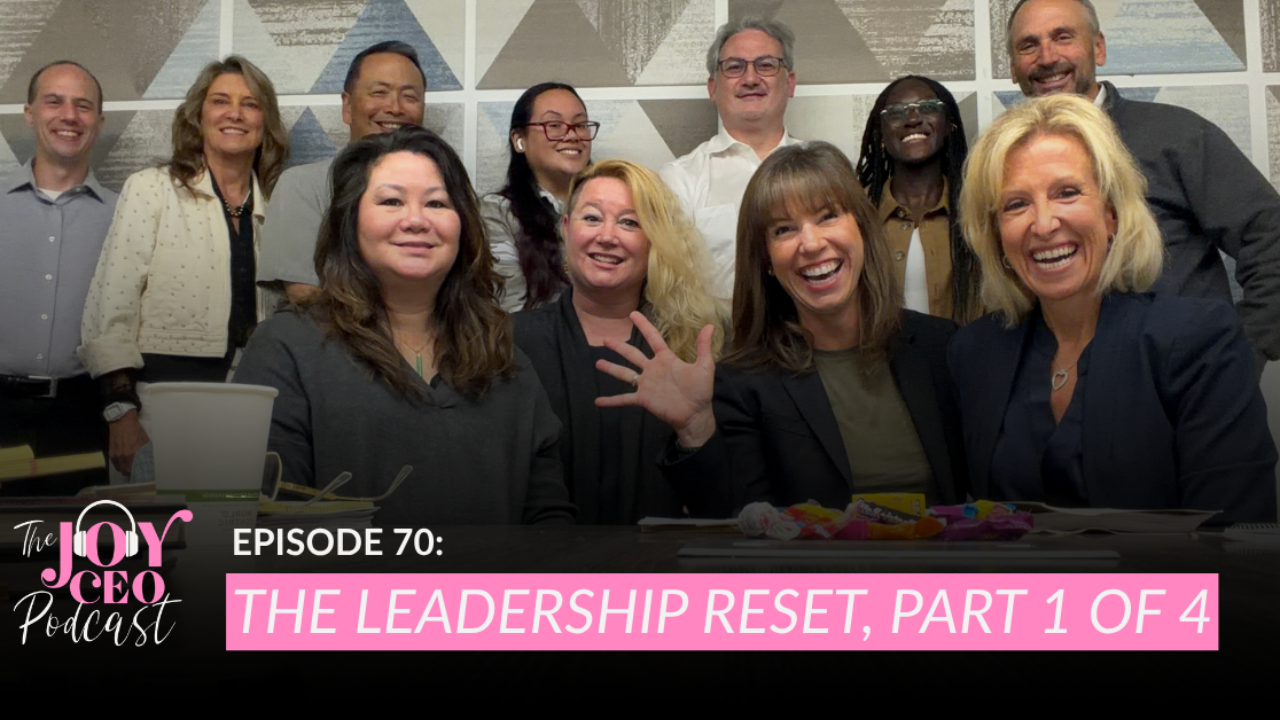
Episode 70: The Leadership Reset, Part 1 of 4
Sep 23, 2026What if your team isn’t overwhelmed because they have too much work? What if they’re overwhelmed by the guessing?
Welcome to The Leadership Reset, a four-part series about what you carry, what you choose, what you pursue, and how you stay engaged. In Part 1, I'm starting with the issue I see most in the leaders I coach: ambiguity.
I once inherited a team that looked like it had a workload problem. Deadlines were slipping, work was overlapping, people were waiting on each other, and the finger pointing had started. The obvious fix was to ask for more resources. Instead, I stepped away from my desk.
What happened next is the heart of this episode.
We also dig into new research featured in Harvard Business Review on the three kinds of role stress, and why workload may not be the one weighing on your team the most.
You can't simply hire smart people, tell them to figure it out, and then judge the outcome. Clarity is your job. When your team knows what is expected, they finally have room to do their best work. That is where JOY at work starts. JOY is the strategy.
3 Key Takeaways
- Your team may not have a workload problem.
When people look stressed, our instinct can be to move work around, add resources, or suggest time off. But role ambiguity and competing priorities can be just as damaging as having too much work. - Clear direction is a leadership responsibility.
You can’t tell smart, capable people to simply “figure it out” and then judge them when they make a decision without the information they needed. Leaders need to own the direction, expectations, priorities, and decision-making. - You have to slow down to speed up.
The thinking work may not be visible, but it is essential. When you protect time to get clear, map responsibilities, define priorities, and decide what matters, your team can execute faster and with greater confidence.
🔎 Mentioned in the Episode:
- "Research: Work Stress Isn't Always About Workload" by Gargi Sawhney and Mallory McCord, Harvard Business Review, September 2026: https://hbr.org/2026/09/research-work-stress-isnt-always-about-workload
- Role overload, role conflict, and role ambiguity: the three types of role stress
- Kobe Bryant's line, "You have to work hard in the dark to shine in the light.”
- The Five-Mile Walk – Lori’s personal example of stepping away from the noise, moving her body, and using that space to map out her team’s roles and responsibilities.
✨ Reflection Prompts:
- Where is my team guessing right now?
- When did I last make time for the thinking work my leadership role requires?
- What is one thing I’ve been keeping big because committing feels risky?
- Who owns what, who decides, and what does good actually look like?
- What priorities do I need to make crystal clear for my team?
🧠 Who This Episode Is For:
- CEOs, executives, and leaders managing teams
- Managers whose teams seem overwhelmed, stuck, or unclear
- Leaders dealing with missed deadlines, duplicated work, or unclear ownership
- Leaders who want their teams to move from guessing and waiting to confident execution
- High-achieving leaders who need to make more space for strategic thinking
- Anyone who wants to create more clarity, confidence, and joy at work
📩 Want to Go Deeper?
Follow Lori on LinkedIn to continue the conversation.
- Book a Leadership Strategy Call with Lori: loripine.com
- Explore Lori’s coaching, community, and retreats at loripine.com
🎧 Subscribe to The Joy CEO Podcast
⭐️ Leave a review to help other heart-centered leaders find the show
📲 Share this episode with a leader who needs a little more clarity—and a little less guessing.
Transcript
Hello, and welcome to the Joy CEO Podcast. I'm your host, Lori Pyne, and I am so thrilled to have you here with me today. When your team seems stressed, what's the first thing you reach for? I bet I know. You think, "Oh, they have too much on their plate. The workload is the problem. Let me see if I can shift the work around," perhaps even suggest that they take some PTO, give them a time management training, and assume that everything will get better.
That is the magic manager's toolbox that we pull from. But what if that's the wrong target, and we are trying to fix the wrong problem, hoping it will get better? If you are new here today, [00:01:00] welcome. I am so glad you found your way to me. I'm Lori Pyne. I talk about all things leadership after having led a billion-dollar business working 25 years in large consumer products goods.
If you are back again, thank you for finding your way. You know I adore you and appreciate you coming back with me here week after week to talk about the ways that we can lead better and live better with joy. So, this is going to be the first of four episodes where I'm really going to hone in on how to sharpen leadership skills.
Based on the women that I coach, based on the community of women that I bring together two times a month, the retreats that I do, the mentoring I do with Next Up, I feel like I have a really good pulse on what is [00:02:00] happening with leadership, what is happening in the workplace, and I feel like we're all getting so much advice from so many different directions that we're not even sure what is the right thing to do.
It's kind of like diet mentality when you maybe wanna lose five or 10 pounds and then all of a sudden you're inundated with this one and that one, and do I do low carb, low fat, more protein, keto? And before you know it, y- you don't even trust what it is that you're supposed to put into your body for nutrition.
I feel like we're in that same sort of culture with leadership, and so I really want to walk you through something that I had to do when I was leading a team that was so helpful, and I think that it can help you, too. Okay, [00:03:00] let's dig in. When someone on the team looks stressed, maybe even tells you they're stressed, most of us just assume they've got too much on their plate.
It's too much. So as a good and faithful, dedicated leader, I'm going to help solve this problem. We move the tasks around. We offer for them to take time off. We suggest the trainings, and then we go back to the busyness of our own responsibilities And it feels like we're really responsible, it feels like we're paying attention, and it feels like we've solved what needs to be solved.
But there's a new Harvard Business Review article, and I'll link it in the show notes, that challenges this assumption. It actually says that based on the study that they did, they found that workload [00:04:00] is only one of the stressors, and not necessarily the most damaging one. There is role overload, too much work.
Yes, and I think in a lot of industries, in a lot of companies, in a lot of positions, work overload is real. There's too much, too little time, and we're expecting more of our people all the time, and that then creates a ripple effect into both emotional and physical symptoms. And so the fix kind of becomes, you know, what choices do we actually make about the business?
Where are the priorities? And are your priorities in line with what will actually make the biggest impact on the business? Net revenue, net profit, money to the bottom line, sales [00:05:00] impact. How are we treating the supply chain And so we'll get more into this in another episode. So role overload is one. The next one is role conflict.
There's too many competing demands, and nobody can really land on what is required of that actual role. This one drives burnout and turnover, and it always, almost always starts way above the team. This is really a leadership communication issue, and it's because leaders are disagreeing about priorities.
The third one, and this is the one I really wanna talk to you about today in this episode, is role ambiguity, that your people may be very unclear about what you expect of them. They just don't know. Now, [00:06:00] sometimes you have veteran people, they, they know. They've been around the block long enough to know.
But your newer people, whether they're new to the company, new to the workforce, they're younger and not as seasoned, role ambiguity is taking them out. It's damaging job satisfaction and their performance. It's also eroding their confidence because they don't know what you want, they don't know what's expected of an assignment, and they don't know how to do it well, and that puts them in to a sort of freeze mode.
And while they could make assumptions, there's a fear of getting it wrong. So here's where leadership is responsible when it comes to ambiguity. We have to own the [00:07:00] direction and the expectations of the business. You can't just delegate that. You can't just say, "Hey, you're really smart. I hired you. You get paid a salary.
Just figure it out." That's not fair. What has to actually happen is whose call is this? Who is responsible to give clarity? Because if somebody just goes and figures it out, does what they think you want done on a project, an assignment, a customer call, then how will you be able to respond when they get it entirely wrong?
You might not be able to because they didn't have clear direction. This also leads to a lot of wasted time where your employees are uncertain. Do I wait for her to give me input? [00:08:00] Do I just go ahead and do it? Where do I get feedback? Do I go to her? Do I go to somebody else on the team? And it's wasting time.
You can't afford for that. When nobody decides who's doing what, capable people are waiting. They're waiting. And it's not that they're passive, it's that they're waiting for permission that nobody seems to be giving, and yet these are smart, capable, bright people. It hides. It, it doesn't announce itself as this leadership problem, but what's really happening in a busy, busy team is there's work that needs to be done, people wait, maybe they go ahead and do it.
The work needs to be redone. There's meetings about the work. Somebody has to decode those meetings and say, "What did it actually mean?" And then we're missing deadlines, [00:09:00] and we're not getting to the point So let me tell you about the common trap. I hired smart people, they will figure it out. It sounds like empowerment, but really what you're doing is you're leaving smart people guessing because you didn't give them the clear direction that they need to actually do the job that you expect.
So without clear direction and guessing, then judged on guesses they should have never had to make in the first place, it becomes kind of this big fat mess. So let me tell you about a time when I inherited a team and things just weren't working well. It didn't seem like there was any synchronicities. It didn't seem like people were clear on what was expected.
There had also been an acquisition, and so there were a lot of things to these people's [00:10:00] credit that were new to the business that they just didn't know about. It hadn't been clearly explained, nor had it been very smoothly integrated. How many of you have been through mergers and acquisitions where the integration is less than smooth?
Yes, I've been there. So what it looked like before is we had people waiting on each other. There was overlapping work, no clarity on who owned what, and missed deadlines. And missed deadlines meant we didn't get the order. When you're a sales team and you don't get the order, you don't get a chance to get that second order because production's waiting on the order.
Some of these were seasonal deadlines, so only once a year do you have those displays or do you have those products in the market. And if you miss them, you don't get a second chance. You just get a big fat zero on your [00:11:00] report card, if you will. So this is what I was inheriting. Missed deadlines, ambiguity.
Nobody knew who owned what. And then a new piece of business was added, and nobody knew how to work with this piece of business, the leader on that business. They didn't know how to integrate it into their portfolio, their divisions. So from the outside, it looked like everybody was just overwhelmed and too busy, and we had a workload issue.
And the obvious thing was to ask for more resources to increase headcount. But in my gut, that just wasn't it. That just didn't seem right So I needed some clarity, because what was happening just was not clear to me. So what I did was I stepped away from my desk and I went for a walk. I [00:12:00] had to get out into nature, and I had to move my body and move the energy.
Because when things aren't going well, everybody just wants to inundate you. They want to tell you all of their problems. So I was getting a lot of that. I was new, I was open, I was trying to listen and receive feedback. But at this particular moment in time, I needed to check in with myself. What was my experience and intuition telling me was happening in this situation?
So I stepped away in the middle of the day, and I walked for five miles. There's a lake here with a path, and it's in nature, and I'm walking through the woods. I talked out loud. Nobody was on the trail, and I just talked it all out loud. And I mapped things in my head, and I sorted through each role, each person.
What were they doing? Where was the overlap with the [00:13:00] person next to them? And when I got back to my car, I had a notebook in the car, I scribbled it all out. Like it just, it was like a download from my head to that notebook of everything that I had just walked through. And then when I got back to my desk, I took everything from that notebook and I started to lay it out.
Now for me, I can't automatically go into my computer into a PowerPoint. I have to whiteboard it. And when I say whiteboard it, I literally take eight and a half by eleven paper and I doodle. I start to scribble it out. And so that's how I start to make my PowerPoints first that way, and then I can put it into a PowerPoint.
And so I started to lay it out and map it out and started to get an org chart to come together. And the org was gonna look very different than what it did today. I was gonna add a couple of layers, [00:14:00] and people were gonna report into people that they hadn't, and we were gonna streamline some of the business.
And that clarity on who was gonna own what was critical because then I was able to line up how would we track it. What were the dashboards that I needed to track the business so that deadlines were not missed, so that everybody knew exactly what was the critical KPIs that they were going after, and that they all owned them Those key metrics so that they could get improved just across the board.
And that team went from waiting and finger-pointing to moving. And I'm telling you, it didn't happen overnight, but it happened really fast. When I got clear, they got clear. [00:15:00] When I was able to articulate it in a way that was seamless, they understood it. And that's what I think most teams are missing. They need your clarity.
They need you to spend the time doing the work so that when you come out, they understand exactly what they're meant to do. Kobe Bryant talked about this. Kobe Bryant says, "You have to work hard in the dark to shine in the light." It's true. Whether you're an athlete, whether you're a leader, whether you're on a team, you have to do the work in the dark so that you can shine in the light.
You can't become the number one sales team in your organization and stand on stage and get an award if you don't do this work that says, "How can I make sure every single [00:16:00] person on my team is abundantly clear about their role, their expectations, what they are to be doing and not doing every single day?"
That is your job as the leader, and if you're unclear, then you demand it from your managers. And if you're in a leadership position where you have bandwidth, then you start to make the rules. You drive the vision. You drive the strategy. You take this business into a place where it is going to grow and thrive and come into its next version of itself, and that is what leaders do And you can do it.
But there's risk in being the person who makes the decision. There's risk in being the one who sets the tone and leads the team. What if you don't set the right direction? What if it fails? [00:17:00] What if it doesn't all work out? You might be wrong. You might be wrong in public. Here's the thing, no risk, no reward.
But that risk doesn't disappear when you stay vague. Staying vague with your team doesn't mitigate risk. In fact, it will just make the vagueness obvious. If you commit and miss, it lands on you. If you stay fuzzy and kinda give the direction and it goes wrong, it's going to land on the team, who guessed without the information they needed.
Now, clear is not the same as certain. You can say, "Here's the direction, here's what I don't know yet, and here's when we'll look again." It's still a commitment, it's just a smaller one. Nothing is forever, and you [00:18:00] can always change your mind. You can give direction, you can make commitments, and then you can say, "We need to pivot.
We have new information," and you can pivot. So let's go to the Kobe Bryant quote, "You have to work hard in the dark to shine in the light." Hard work done when nobody sees it lets in the light. The dark work for a leader is the thinking work, and yet we don't make time for it. If I know you, your calendar is probably double-booked most days.
In some instances, you're probably triple-booked. You barely have time in between Teams meetings or Zoom meetings to even go potty. Lunch, if you take it, is on the go and probably consists of something from a cellophane bag. Or if you had the bandwidth, you did pack yourself a [00:19:00] salad. Maybe the team's having a meeting today and you're in the office and there's something being ordered in, and that's about the extent of it for you But deciding direction, setting priorities, and getting expectations clear is critical, not just at the macro level, but at your level, the level that is impacting you and your team.
And it's not like anybody's gonna breathe down your throat and watch it happen, but it will transform you as a leader and your team in the way that they react to you and the way that they show up with you. You have to slow down in order to speed up, and this is what that means. You slow down to do the thinking work, you slow down to get clear, just like I did that day at the lake, and then you execute.
You speed up. You [00:20:00] start winning. You start taking credit for the wins because you did the work in the dark. The trap for busy leaders is that meetings are visible, thinking work is not. So the thinking gets squeezed first. You might put some space on your calendar and say, "Okay, this afternoon I'm blocking an hour, I'm blocking two hours," and then guess what?
That time gets hijacked. Somebody needs you. There's a crisis. Things are falling apart, and you take that time, and you give it away. So there has to be time that you protect, and you keep it sacred. For me, I had to just walk away, out of the building. Out, there I went. Nobody could reach me. I needed that time.
Okay. No team will improvise without a game plan. If you watch any sort of sports, you know they all have a game plan, they all run plays. Your [00:21:00] team is no difference. You need to study the game film. You need to know what's happening. That's where the clarity gets built, in the dark. So how are you gonna do your thinking work?
Are you gonna take some time? Are you gonna move your body, move your energy? Or are you gonna do it differently? There's all sorts of ways to do it. For me, that's what worked. I had to shut out the world, shut out social media, shut out everybody, and just get in touch with my own inner knowing, my own higher self, so that I could understand what my own intuition was telling me to do with this team Your four moves for this week.
Are you ready? This is what I would suggest you do so that you can apply this to your leadership. One, block real thinking time. Not the calendar hold that you know is going to get hijacked, but whatever it, it [00:22:00] is for you, that would be the version of my walk. Like I said, maybe it's not a walk for you. So what would your version of that be?
Block it, hold it as though it's an appointment you would never cancel, and make it happen. Write down the direction. What matters most for this quarter, for the rest of this twenty twenty-six? What does good look like? Who owns what? Who decides? Be crystal clear. Track what matters. You have to set up the tracking.
When you track what's important, then it tells your team, "These are our priorities. This is what we're going after." Do this after the ownership is clear Commit with a review date. Make sure that if you have a standard practice of your one-on-ones, that this is part of that conversation. If you don't have a standard practice of one-on-ones, that you're bringing the team in and you're [00:23:00] discussing this regularly so that they see the tracking, they know that your eyes are on the priorities, and then their eyes will be on the priorities.
And last but not least, how do we bring joy into this? A team that knows what is expected of them, that isn't guessing, that isn't waiting, has room to breathe, and that is joy. That is joy in leadership strategy, and it's not just some sort of perk. That is the real stuff that will differentiate an average or mediocre team into an outstanding team that can thrive.
So couple of reflection prompts if you want. Where's my team guessing right now? When did I last do my thinking work? And what is one thing I have been keeping big because committing [00:24:00] feels risky? Ooh. All right. Next week, what do you do when there is simply more work than your team can handle? We're gonna get into it, because likely, absorbing it yourself or pushing harder are both the wrong answer.
All right. I'm Lori Pyne, the Joy CEO. I love being here with you. If you loved this episode, please share it with a friend. If you have any interest in any of my services, one-on-one coaching, joining my Connect, the community of amazing women that join me twice a month, or if you want to come to my upcoming Hudson Valley retreat, please reply and let me know.
You can find me on Instagram or on LinkedIn, and just slide into my DMs and tell me you're interested. I would love to tell you more about this amazing work. Until next week, my friends, lead with [00:25:00] joy. See you soon Thanks for listening to The Joy CEO. I hope today's conversation left you feeling seen, stretched, and a little more grounded in your own joy.
If something resonated, be sure to hit subscribe, leave a five-star review, and share this episode with someone walking a similar path. And if you're ready to take this work deeper, connect with me on LinkedIn or Instagram @loripine, or head over to my website, loripine.com, to learn more about coaching, retreats, and how we can work together.
Because joy isn't just personal, it's powerful, and when you lead with joy, you don't just rise, you bring others with you. Until next time, keep leading with heart, and don't forget to claim your joy.
