
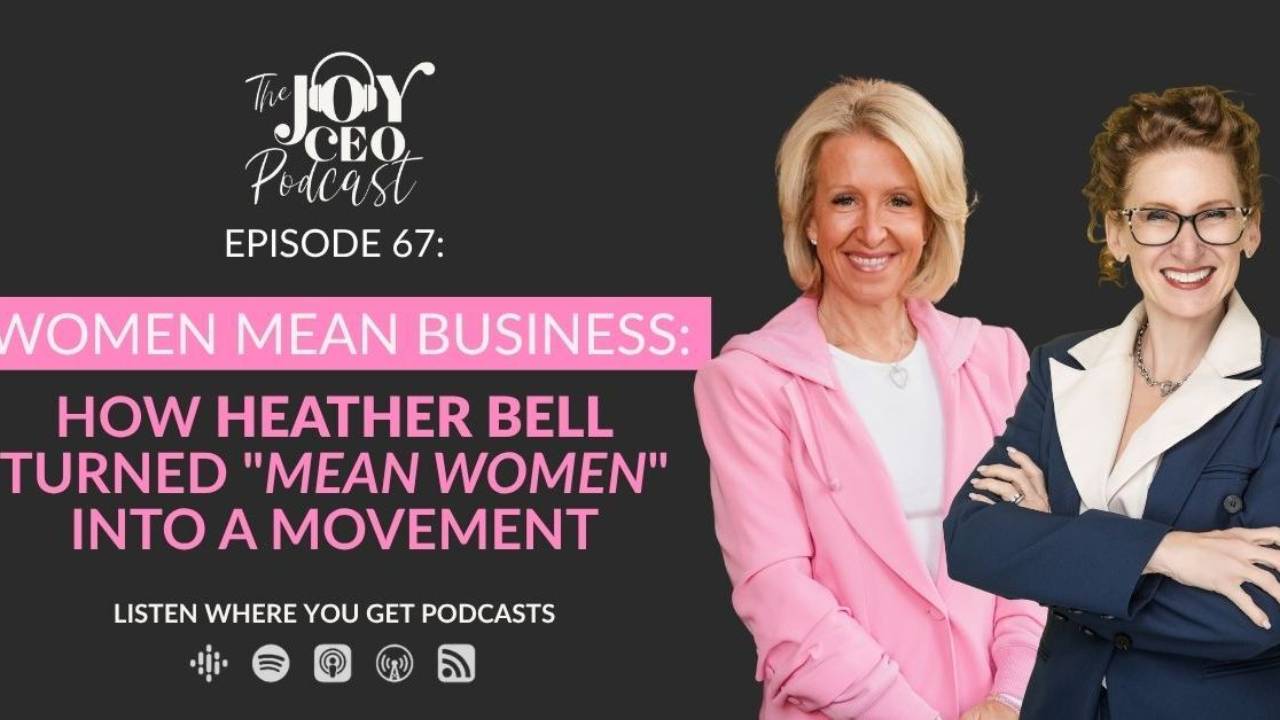
Episode 67: Women Mean Business: How Heather Bell Turned "Mean Women" Into A Movement
Sep 09, 2026In this inspiring conversation, Lori sits down with Heather Bell, CEO of the Orange County Chamber, to talk about resilience, leadership, entrepreneurship, and what it really takes to build something that lasts.
Heather shares the winding path that brought her to leadership—from being a single mom who went back to school at 30, to building a career at Heineken, taking a leap into entrepreneurship, leading at the YMCA, and eventually stepping into the CEO role at the Chamber during the chaos of 2020. Four years later, the Chamber was named New York State’s Chamber of the Year.
But this episode isn’t just about professional success. It’s about knowing when to take a risk, surrounding yourself with the right people, building a team instead of trying to do everything yourself, and leading with compassion without compromising accountability.
If you’re building a business, leading a team, or wondering what your next chapter could look like, this conversation is full of reminders that resilience, connection, and knowing your “why” can change everything.
🔑 Key Takeaways:
You Don’t Build a Career or Business Alone
Heather’s journey is a powerful reminder of the importance of mentors, connections, and knowing when to ask for help. From leaders who saw potential in her to hiring the right people as an entrepreneur, she learned that success isn’t about doing everything yourself—it’s about surrounding yourself with people who can help you grow.
Resilient Leadership Means Knowing When to Adapt
When Heather stepped into the CEO role, the Chamber was struggling financially and lacked a clear vision. She created a 90-day plan, rebuilt the team, focused on delivering real value, and stayed committed through the challenges. Four years later, the Chamber was named New York State’s Chamber of the Year.
Joy Comes From Knowing Your Why—and Lifting Others Up
For Heather, joyful leadership means loving what you do, knowing who you’re doing it for, and seeing the impact of your work. She finds particular joy in watching her team grow and succeed, believing that great leaders don’t need to be the center of everything—they create space for others to shine.
🔎 Mentioned in the Episode:
- Orange County Chamber – Heather’s work building membership, partnerships, programs, and community impact.
- Heineken USA – Where Heather began developing her corporate relations, government affairs, and community relations experience.
- YMCA – Heather’s leadership experience, including Executive Prep Institute and growing programs by 80%.
- Chamber Grow – Heather’s entrepreneurial success program, designed to help business owners understand the value of investing in support and professional expertise.
- Launchpad Program – A business academy for graduating seniors interested in entrepreneurship, culminating in a Shark Tank-style pitch competition with a $5,000 prize.
- Women Mean Business – A Chamber initiative focused on Mentoring, Empowerment, Authenticity, and Networking.
- New York State Chamber of the Year – The prestigious recognition the Orange County Chamber received after Heather’s leadership helped transform the organization.
✨ Reflection Prompts:
- Where are you trying to do everything yourself instead of asking for help?
- Who are the mentors who helped you become the leader you are today?
- Are you leading people—or simply managing tasks?
- Where could you create more space for your team to step up?
- What is your “why,” and is your current work actually answering it?
🧠 Who This Episode Is For:
- Entrepreneurs who are trying to grow without burning themselves out
- CEOs and leaders building stronger, more empowered teams
- Women navigating a career pivot or second act
- Business owners learning when to delegate and invest in support
- Leaders who want to build with compassion, resilience, and purpose
- Anyone wondering what their next chapter could look like
📩 Want to Go Deeper?
Follow Lori on LinkedIn to continue the conversation
- Book a Leadership Strategy Call with Lori: loripine.com
🎧 Subscribe to The Joy CEO Podcast
⭐️ Leave a review to help other heart-centered leaders find the show
📲 Share this episode with someone who’s navigating pressure and wants to do it with more grace
Transcript
Hello, I'm Lori Pine, the Joy CEO, and welcome to the Joy CEO Podcast. I'm so thrilled to have you here with us today with an extra special treat. You are going to meet my dear friend and the CEO of the Orange County Chamber, Heather Bell. Heather, welcome. So glad to have you here with us. Thank you so much for having me, Lori.
It was such a pleasure to be asked to join you. Oh, such a treat. You know, I get to see you at all these chamber events, and, you know, you're so busy and everybody wants your attention, so now I get you undivided for a full hour. You can have me any time. I can ask all the questions, and there's so much to unpack because you've had a really interesting career, and some exciting things have really unfolded over the past year that, that we just really wanna get into.
So let's just tell everybody a little bit about yourself and just have you say hello. Hello, I'm Heather [00:01:00] Bell. I'm excited to be here. I really, truly am. What an honor to have been asked. So a little bit about me personally. I was the oldest of five children. My parents adopted my, my cousin and my uncle, who are two years younger than me, and then they had my sister and brother, and subsequently my uncle passed away from muscular dystrophy, and that was the reason why they had to be so active in his life, is because my grandparents really couldn't handle the disease and, and what care he needed.
So my dad worked three jobs. He retired from General Motors. My mom was a bookkeeper and a hairstylist by trade, but her primary job was taking care of us five kids. So yeah, it was... I, I had a very blessed upbringing that you learn to appreciate when you're an adult. I, I look back now and I realize where a lot of my resilience comes from, and it's from my parents.
And my dad was very adamant in me [00:02:00] understanding at all times that even if somebody tries to knock you down, you stand up, you walk tall, and you tell them, "I am Heather Bell," and you just keep moving on. So I have, I have some really strong roots there. I am a mom of two wonderful boys. They both served in the Marine Corps.
One is a deputy sheriff in L- outside of Orlando, Brevard County. And the other one is... They're both superstars, but Jason I'm just so proud of. He went up to Potsdam. He majored in fraternity, had a perfect 2.0. And then he went in the Marine Corps, and he is now really high up in the ranks of a international crane company.
He makes tons and tons of money, does- he does- he loves, loves, loves his job. So I'm very, very proud of him. With the skills that he, he learned in the Marine Corps, he was able to do this. And he's got my beautiful two grand babies. Look at that. Yeah. Yeah. And so I was a single mom from the time they were four and two, and recently got remarried on December 31st [00:03:00] of 2020 Oh my gosh, Heather, we have so much in common.
I didn't even know this. Okay, so let's backtrack. My parents also raised my first cousin. So I have a brother who is biologically a first cousin when my m- mom's sister passed away, and he was only seven. So same, and I think that there's something special when that happens in a family. You, you grow compassion and empathy, and your heart expands, and you, you're able to hold more in your...
When your family grows like that, so. Yeah. I too am a boy mom, just like you, and have that second child who has the capacity to really push and, you know, again, make you expand and hold compassion and empathy with all of their specialness and their genius. And then single moms. Yeah. Yeah. We were both single moms for a long, long time.
For a long time. Two and, two and four is when I- Oh, wow, [00:04:00] really? Same age. Same, same. Same, same. Wow. So look at that. We're in good company. Yes, we are in good... And eldest child. See that? Yes, look at that. Yeah. So all of that becomes so formative and, you know, makes us who we are, which is these ambitious women who really wanna- Yeah
get some s- some stuff done in the world. Yeah. Yeah. I had to... I was responsible for my children. There was very often child support wasn't coming through, and I had to make sure that there was food on their table. And I went back to school for my bachelor's degree when I was 30 years old, working full time and caring for two children at the same time.
So I, I was very, very blessed. My mom and dad helped me a lot in that they, they took care of the boys so that I was able to do that. So I, I wanna make sure that it's understood that, you know, I, I did have help like that. But yeah, they, they were very, very helpful in watching the boys while I went to school, and [00:05:00] I received a 4.0 GPA, something I'm very proud of.
In fact, when I was driving Jason up to Potsdam, he said, "Mom, you set the bar so high. How could you ... What the hell did you do to us?" So yeah, so I went back to school and earned my, my bachelor's degree with a 4.0, and that, that really sprung my career into, into action. Started working for Heineken USA.
Interesting story there. I was a little disappointed that I got hired as an executive assistant. The understanding in my brain was I now have a bachelor's degree, but the price was right, so... And my mom always said, "If you can get in, get your foot in the door," so that's what I did. Six months later, my boss came to me and said...
And this was my very first vacation in I don't know how many years, but I was, I was going on vacation, and he said, "I know you're gonna be looking at your BlackBerry." This is how long ago it was. And he said, "But I just want you to know whatever you see [00:06:00] happening has no bearing on you." Well, they went from a 1,500-person workforce down to 500, and I made the cut.
And it also propelled my career, 'cause I was no longer an executive assistant. Incredible. I was a corporate relations specialist. I was responsible for government affairs for the whole country, our government affairs, and leading our PAC, our political action committee, and I was also responsible for our community relations, specifically in hometown.
And little did you know, all of that would just be the foundation, the breeding ground for- Yeah ... everything that you would do and do today, so wow. Yeah, and I have to give a shout-out to my leader there, Dan Tierno, whom and I are still friends to this day. He saw something in me, and I remember when I was doing my first debate, I was moderating the, the senatorial debate, and I called him because he is just the government guru as far as I'm concerned.
And we, we collaborated on the [00:07:00] questions that I was gonna ask, and he said to me, "I knew you would get this far." And it was, it was really, it really warmed my heart It's amazing when we have those people in our lives who see something in us that we can't exactly in ourselves. We haven't had coordinates or- Yeah, 'cause at that time I was, I was putting food on the table.
I was making sure that the boys had hockey equipment, and, you know, I was coaching so that they could play. And, you know, that, that's where my mindset was. My mindset wasn't 20 years later, what was this gonna do for me? Amazing. Amazing. Yes, amazing when s- people see something in us that we haven't seen in ourselves, and then those people are real mentors- Yeah
and that for- fortitude into what we'll become. Yep. Yeah. Yep. So then Jason was in college, and CJ was already in the Marine Corps, and I kind of w- had a little bit of an epiphany. Like, what am I gonna do when I grow up? My, my... What am I supposed to [00:08:00] be doing? Where's my worth? I'm not rushing to get anybody to hockey practice.
I'm not worried about schoolwork. Like, what am I supposed to do with me? And that's when I decided maybe I wanted to be an entrepreneur So I took a chance. I... And it, it's funny, 'cause it all kinda came full circle at this point. I took $5,000 out of my 401. There was no business acumen training, like, I had to figure it all out myself.
I made absolutely every mistake you could think of. I was down to my last $500 and I was, "Oh, man," and I left a good job, and, you know, "What am I doing wrong?" And I called Marsha Gordon, another mentor, and I said, "Marsha, what am I doing wrong?" And she knew me because when we were with the business c- we were with, when I was with Heineken, the business council was our chamber, per se- Mm-hmm
and we were corporate partners, so I did a lot with them. And so she said, "Come on in and let's talk." And she gave me some pointers, made a couple connections. I hadn't even joined membership at this [00:09:00] point, and all of a sudden my business just started picking up. So I'm eternally grateful to her for that, to the point where it was an event planning business, and I won Best of Westchester twice, and not in WeddingWire client reviews.
Amazing. Yeah, yeah. And I really, I really loved what I was doing. I, it's, I was making my own hours. It, it's a pursuit of happiness, no doubt, being an entrepreneur. You have to remind yourself every day that I'm doing this because I have a dream and I have a vision. Yeah. But from there, I was romanced away, actually, to the YMCA.
So somebody else that I knew in the business world called me up and said, "I want you to be an associate executive director for a YMCA." And I said, "Do we even have YMCAs anymore?" Like, "What do I do?" And it just turned out to be one of the largest inner city YMCAs. They still had residents, so we had 170 residents.
Wow. Swimming pools, fitness facility, childcare starting at six weeks [00:10:00] old, going all the way up through middle school, camps. And I just took a leap of faith. I said, "Okay." If, if, if men can do this, I can do it, you know? Absolutely. How many men look at a job description and they're like, "Well, I got about 80% of the talent, I'm gonna try."
All right, good. Right? Good. Right? I got this. So I said, "Okay," Yeah "... well, I'm gonna do that." And if you've ever worked at a YMCA, it's not work, it's a lifestyle. You really, you begin to embrace it, so much so that I, I was an empty nester. I had no kids at this point, so we had snowstorms and the security guard was coming from the city and I just said, "Stay home, stay safe," and I slept on the floor behind the membership desk to make sure that the residents could get in and out.
My heart is still with a couple of those kids. I bet. I have some really beautiful stories from the children. And then Y-USA tapped in and said, "Hey, we want her to go to Executive Prep Institute," and that's their two-year program for executive [00:11:00] directors. So I went through the program, became an executive director.
We grew programs at that Y tremendously, like 80% growth in programs while I was there. The problem is, is that the building was falling down around us. So eventually they made the decision to sell, and I had to find something to do. Yeah. So I went to another YMCA for six months as a consultant, and decided that maybe it was time to move on.
I couldn't really subscribe to some of the things that they felt were important. Just an example was a very unsecure YMCA, so no alarms, people could just walk in and out. And I worked with the city police department to present a proposal to secure the Y, and they decided to take that money and paint a mural on the side of the building.
So I said, "You know what? We've got shootings around here. We've got gang tags. I can't be responsible if somebody walks up those stairs and starts shooting, so no blood on my [00:12:00] hands, I'm out." And that's when I came to the chamber. I came to the chamber as a director of membership. And that was January of 2020.
Wow. The best time to change careers.
Okay. Before we get into your Chamber journey, let's just unpack a few things that you shared, because there's so much that's important, and mainly that we do not journey through our careers alone. Mm-mm. And it's so important that we have people who help us, that we have people that we can call, that there are people who are generous, people who tell us what to do, people who tell us what not to do, and I know that you are one of those people today for many people in your circle.
Thank you. But to be able... But to also to be able to have that and to be able to receive that throughout your career, what would [00:13:00] you say about leadership in terms of giving and receiving, and how that just manifests into the development of a full-blown career? So I truly believe there is a difference between a boss and a leader Right?
And between a manager and a leader. And I think when I was at the Y, I really-- I embraced that and I realized that I was being too much of a manager and I wanted to be more of a leader. It was me. I wanted it. Nobody said, you know, "You're too much of a manager." I wanted to be inspiring. I wanted to be a coach.
I didn't wanna always have the answers. I wanted people to be able to develop their critical thinking skills and feel like they were empowered in the decisions that we were making and not just being told what to do. So Understanding that [00:14:00] that's where I saw the change in my direction, going from being a manager to a leader, it's also because I had some bosses, and-
there's that, that thing, you know? Be the leader you wanted to have, and I, I very much embraced that- Be the leader you never want to be. Yeah. I very, very much embrace that theory. So it's very important to me that the people that I get to work with every day like to come to where they work, that they enjoy what they do, that they feel empowered, that they feel supported.
I do not believe that being a compassionate leader is a bad thing. If, if somebody comes to me and says, "Hey, listen, I have to work from home the next three days. My, my child has strep throat," I'm gonna get a better response from my team if I am compassionate and say, "Do what you have to do, because family comes first," versus, [00:15:00] "Well, you better figure it out."
Yeah. Yeah. Did I answer your question? You did. You know, it's, it's being able to have people in our corners who meet us where we're at- Yeah ... who, who give us the advice and the, the love a- as we need it. Yeah. Yeah. And I think you, you give that and you've received that. And I think you've probably gone through your career in the same generations that I have, in that, you know, there was a time that there was no work from home, and- No, no
being a single mother, I dragged myself to work sick as a dog, flu, whatever it was, because the time that I was able to take off, and usually it was that I had two weeks vacation and five sick. So if one of my kids was sick, that was when I had to take the time off, and I remember always saving my vacation to the end of the year in case I needed to be home with one of the boys.
And [00:16:00] then if not, then I got to take the week in between Christmas and New Year's off with them. Yeah. Yeah, yeah, yeah, yeah. Yeah. Yeah, or one of those sacred weeks where I would, you know, wanna be at the lake in the summer or something. You know, actually do something fun. Yeah, yeah, yeah. With them. Okay, so then a pivot, and you make your way to the Chamber.
It's 2020, and all hell's about to break loose. In the best way. So end of January, we have this big gala, it's called the Snowball Gala, and here I am, my first year as director of membership. 400 of our closest friends are, are at Anthony's Pier 9, and that was Saturday night, and by Tuesday I was sick as a dog.
I had really high fevers, couldn't smell anything, a horrible cough. Oh. Yeah. Yeah. And I was told that I had possible flu. [00:17:00] So I wound up being home for, I think, nine days, and then fast-forward a month and a half later, everybody had high fever, a cough- No tape ... possible flu. Couldn't smell anything, couldn't taste anything.
So yeah, I started my journey with the chamber the year of the pandemic. We shut everything down. We went and worked from home on our own personal devices, 'cause we all had lapt- or desktops at the office, which was a, a hacker's dream that people were doing this. In fact, I wound up having my identity stolen during that time because my personal laptop at home wasn't as secure as the desktop, so they hacked in and needless to say, I, it took me a long time to get my identity back.
Oh my gosh. Yeah. Yeah, it was not a fun journey. But fast-forward through that year, we were able to grow membership because I was showing people what the value of a chamber membership was. We were the ones that had the [00:18:00] credible resources. Everybody else is trying to pick and r- around the internet and, "Can I open?
Can't I open? What's the six feet?" Every question at, that a business owner had, and, "Where do I get funding?" And h- The loan ... "Can you help me with my EIDL? Can you help me with my PPP?" And we were able to provide that. So that's when we start to see a little bit of growth in the chamber. So January of '21, the board called me and said, "We need to, to meet with you," and they let me know that they had made a decision to change leadership, and they asked me if I would be interested in president and CEO.
And here we are. Yeah. And so you get the tap on the shoulder, president, CEO. Did you have a vision? That day, no. When I went home and really put some, some thought and intentionality to it, yes. In fact, I decided that I to- [00:19:00] I took the step to provide the board with my 90-day plan. They didn't ask for it, but I said, "You know what?
This is, this is what my vision is for the next 90 days. This is my vision for the next year. This is how I'm going to accomplish it, and these are, these are the tools and the resources and the support that I need from the board to do so." And they embraced it. Not once did they ask me for a recap, but at every board meeting every month, I gave them an update.
So I, I held myself accountable to what I put into practice. My vision at that point was to save an organization that was failing very badly. We, we did not have very good finances at that point, and so I put intentionality into how we were going to increase our revenue and also increase membership, but in a way that we were intentional, and what benefits are we providing?
So I [00:20:00] didn't hit the ground running and say, "We need to grow membership. Let's start now." I started to think, "Okay, what benefits are we providing to people? Where's the ROI?" And that's something that I've continued to do every year since being asked to take this leadership role. I constantly wanna show that ROI, and I am proud to say that I have not increased the investment dues of the chamber since 2019, actually.
Wow. While increasing benefit. And while still demonstrating the value. Right, right. Here's the value you get by being- Yeah ... a member of the Orange County Chamber. Yeah, yeah. Yeah, yeah. And keeping dues low. So, but, you know, my vision, too, was not just to be a membership association. I wanted us to be supporters of community.
I wanted us to be strategic partners. I wanted us to be viewed as someone that deserved a seat at the table, which at that point we really didn't have that best reputation. So now, now we are on the economic development [00:21:00] task force. Now, we get called to sit on, you know, protect our power task force with the energy companies, and we're invited to meetings with the Business Council of New York State.
I was, for a while, the chair of the Chamber Alliance of New York State. So it w- I was very intentional in our strategic partnerships, but also in building the reputation back that the chamber deserved. Yes. So you were in role four years when the chamber receives a very prestigious w- award. Yes. Yes, that's, that's one of the highlights of my career.
I bet. So we won the Chamber of the Year from the New York State Chamber of the Year from the Business Council of New York State. I mean- And, and- Bravo ... there are 124 chambers in the state. 124, and you are number one. Yeah. And four [00:22:00] years prior, you're failing, your finances are in the toilet, you don't have a vision, nobody knows who you are or what you're doing.
Right. Yeah. Wow. Yeah. What do you think- But you know what? I have to say that this team shows up every day so passionately about the work that we do. They deserved that award. That, that was, that was the team's award. That... And, and I can't say this enough how blessed I am to work with the individuals that I get to work with because they, they know their, they know their stuff, and if they don't, they know that they have the support, that we can figure it out.
Okay, I want to challenge you on that a little bit. Okay. Because you had the same team before, right? Nope. So they were j- just under, under a different leader? No, when I took the job over- Or is this a- ... there were only two people besides myself. Okay. So you brought in a whole new team, [00:23:00] and that was part of your vision.
Yeah. You, you said, "If I'm gonna do this, I'm gonna do this my way." Yeah. Yeah, okay. And I realigned. When I first took over, everybody was a director. It was the president, and everybody reported to the president. Everybody was a director. Yes. So I have built layers of- Yeah ... reporting structure now as well.
Amazing. Amazing. And you do have an incredible team. It is like a symphony the way they work together, the way they make events happen, the way there's communication. So what do you think it was in four years that you brought to the table that really moved the needle? Resilience and tenacity Yeah I wasn't going down.
We weren't going down And were there moments when it felt like you might?[00:24:00]
I remember when one of the, the team left, and I had to stop. I was on this, this trajectory going this way, and I had to stop what I was doing, leave that there, come back over here and pick up the pieces. And I thought, "I shouldn't be over here. If we're gonna, if we're gonna be successful, I need to be back over here."
And rather than qui- cry about it, I called Here's Help and said, "Get me somebody." Yes. "I need a person." Yep. "Get me somebody that I don't have to teach absolutely everything to, that can pick up the ball and start running with it." And that's what he did. Let me ask you something, because this is something now that I'm in the entrepreneurial world that I'm observing- Mm-hmm
that I didn't observe in the corporate world. In the corporate world, I feel like I [00:25:00] learned that I'm never going to be able to wear all the hats. Yeah. So I'm always going to have to find a person to do the expertise that I don't have. Mm-hmm. Like, I was just trained that way in the corporate world. But over in the entrepreneurial world, it seems like there's this train of thought that people are gonna wear all the hats, they're gonna do all the jobs- Yeah
and they're gonna burn themselves out. They're literally going to kill themselves- Yep ... trying to do all the things. Mm-hmm. And I look at that and I'm puzzled about that thinking. And you came from a corporate background. Y- your first job was with Heineken, so you too are trained like me. Like, "Oh, no, I, I can't do that, so- Yeah, yeah
I need a person for that." So, and you just gave that example where you were like, "Oh, that person left. I'm now over here in the muck. I, I can't be successful if I'm doing this person's job. I need to [00:26:00] get a temp agency to get me a person." Yeah. What do you think about those two schools of thought? So it's actually something that I teach in our entrepreneurial class.
So I wrote a curriculum for an entrepreneurial success program, and I brought it to the SBA and the SBDC and got it approved by them. So it's, it is- I love this. Yeah. So it's called Chamber Grow, and it's led by our industry leaders. It's taught by our industry leaders. They have to fol- follow the curriculum that I had approved.
But one of the things that I share is that the biggest investment that you can make in your business is seeing the value of either hiring somebody or consulting out. So if you find that you're too busy to keep up with your schedule or your billing or whatever, that means that you need to keep growing your business and you need to hire an assistant, whether it's a part-time assistant, a virtual assistant.
If your [00:27:00] value is in growing your business and you struggle with QuickBooks and with account, hire a bookkeeper. And that, it will more than pay for itself. And that's something that I didn't do when I was an entrepreneur. I struggled to do all of it. And- Yeah ... that's when you start to fail. You, "Oh, I, I didn't write that contract correctly."
I mean, how many times have you gotten a document and you look at it and you say, "That's not even my name on it"? Like, that's the kinda stuff that gets dropped, because you're in such a rush to send the cookie cutter, and you're not paying attention to the details, and it does not represent your business- Yeah
in a manner in which you want to. So my best advice to any entrepreneur is when you start to get to that point, recognize, even for your own mental health, you cannot do it all. You should not do it all. Employ a professional. Yeah. What would you say to the person who says, "But I'm afraid of hiring the wrong person.
I'm afraid of wasting some money"? What do you t- what do you say about that [00:28:00] fear? Being an entrepreneur is a risk. Always. I have hired people that didn't work out. I'm not afraid to say it. It's a risk. You... Yeah. People put on their best face at their interview. Mm-hmm. A resume is an inflated version of what you want people to think of you so that they'll bring you in and get in front of you and consider you for that job, right?
So you don't write in layman's terms on resumes. You make sure that you're using your thesaurus and it's- Mm-hmm ... you know, it's grammar-checked and- Mm-hmm ... I mean, let's ju- I'm, I'm calling a spade a spade, right? The same thing with re- re- references. Do you give people that fired you as- No. No ... right? No. Do you give, you know- No way
a past coworker that you couldn't stand as a reference? No, you give all the people that are gonna say wonderful things about you. But that's, that's checking a reference. Yes. Why bother? Because they're all gonna tell you what, what that person wants you to hear. [00:29:00] Yeah. So you gotta... It's all about taking risks.
And, and I consider myself still an entrepreneur because this might as well be my own personal business, and I take risks. Yeah. I took a risk when we, we... When I took the chamber over, we were, again, failing terribly financially, and in order to be fiscally responsible, I could not stay in the office space that we were in.
We were paying almost $7,000 a year in rent. We did not need the space that we had. I offered it back to the landlord fully furnished, offered to put up a wall to divide the space. Landlord said no. I said, "You know what? Litigation isn't a good business model." And we moved out, and four or five months later, we got the letter from the attorney, and I negotiated down.
I paid 10% of what they wanted from me. Well done. Well done. We, we had a much smaller home here. It was a, an old historic house. For three years, that was our office- Mm-hmm ... and we outgrew it. And now we have a beautiful office thanks to [00:30:00] Wallkill Valley Federal Savings and Loan in the city or town of Newburgh.
You know, I also got a lot of flack for moving us from the county seat in Goshen to Newburgh, but w- people don't need to come to us. We're the chamber. We come to everybody else. You, you can, you can come here if you want. We have a beautiful office to welcome you. But every one of my staff, including myself, we are constantly mobile within the entire community, so it shouldn't matter where our office is.
And you are. You're do- constantly doing events all across the county, so people can find you and- Yeah, and we go out and visit our members and, you know- Yeah ... we'll meet you where you are. We don't... We have no expectations that you have to come here to this office to meet with us. We will meet you virtually.
We will come to your office, your store, whatever it is. Yeah. I love that. I love that. Yes. And what a fiscal, you know, a very conscious fiscal decision to make. Those decisions aren't easy. Yeah. And, and we wouldn't have survived [00:31:00] the first year if I stayed there. Well done. Thank you. Well done. Yes. So what's on the horizon for you, for the chamber, for, you know, how do you top being New York State's number one?
How do you... What do you do? You know, we kind of thought like, "Yeah, we're number one in the state. We're doing something right." But that lasted all of like two clicks- Yeah ... and we said, "We gotta do more." So this year in particular, we started hosting some summits. We had a non-profit summit, we had a cybersecurity summit.
You can expect '27, we'll have many more summits that focus on business strength and improving and support. This past year, we also introduced the Launchpad program. So we took that Chamber Grow and we decided that we were gonna do it for graduating seniors that wanted to be entrepreneurs. And in doing so, so we did a one- one-week business [00:32:00] academy, and we ended it with a Shark Tank style event.
It was a live audience where they had to present to a brand-new panel. So we had an el- elimination round in front of one panel, and then we had a brand-new panel that Monday night, and the winner walked away with $5,000 to start their business. I love that so much. I actually happened to be in the audience that Monday night.
Yes. It was so fantastic to see these young kids, if you will, you know, with their ideas and their presentations and so bright and just... It was fantastic, so. And unique ideas. I mean- Yes ... they, they really... Even the web developer, he wasn't just a web developer. He had marketing statistics and, and he... I was very impressed with what they came up with.
Yeah. Yeah. It was really great. So yeah, so you are doing a lot of new things, a lot of creative things, ways to continue to bring value. Yep. Are you seeing an uptick in new businesses in the [00:33:00] county? Yeah. Yeah, yeah. But similarly, we're also... So we track our new members, where they come from, and we track anyone that chooses to dissolve their membership, why.
Mm-hmm. And the biggest reason why we see the dissolution of membership is because they've either closed, they've unfortunately passed away, or they retired and moved. That's the biggest reason. After that, there's financial difficulty, and then following that is lack of engagement with the chamber. And those are usually the people that we can talk to and bring back because they're just not, they're not aware of everything that we're doing.
Mm-hmm. So, but similarly, we're seeing a lot more new businesses opening up, and I would say they haven't evened out yet. We're seeing a little bit higher uptick in the, the businesses that are closing. The new businesses haven't really caught up just yet, but it's very, very close. Amazing. [00:34:00] Amazing. Tell me what the idea of joy in leadership means to you
I really thought about that question 'cause I knew it was coming.
Joy in leadership to me is enjoying what you do, enjoying who you do it for, and knowing that there is a why, that why is being answered. Why do I do this? Who am I working for? I absolutely love what I do. We were talking before we came on, and I was saying that, you know, I don't necessarily see that I have to retire.
I love what I do. If I had to work 365 days a year, I could do that, because just like I said with the YMCA, it's a, a lifestyle. This has become something that I embrace very [00:35:00] passionately, my ability to work with businesses and nonprofits and help them grow and succeed, and to sit back and say, "Yeah, the chamber had a hand in that."
Yeah. Yeah. I couldn't agree more. You know, really being a joyous leader is just being your most authentic self. I, I believe joy lives within. We can choose it at any time. Mm-hmm. We just make the choice. And I love lifting others up. I don't know if you, you've noticed at the, the Business for Breakfast, I'm not...
I have a very small role in them now. I do my remarks in the beginning, and I'll introduce the, the keynote. But other than that, my team is up there doing their thing. So Tammy is up there talking about events and programs, and Frank is up there talking about membership. I never want somebody to think that this is the Heather chamber.
This- Right ... this is the member [00:36:00] chamber, and it's important to me to elevate the team as well, and I love it when I sit back and I see Tammy up there at the podium, or I watch Frank talking to members and, and it just, it brings me a lot of joy. I love that. Yes. Yes. And you can tell that you are very passionate about that, because you do an excellent job of, you know, when a rising tide rises, all boats rise, and you certainly emanate that.
Yes. Thank you. And the chamber does a great job of having some very distinct programs, like the Women in Business- Yeah ... Women Mean Business, and that's been a really successful program for you. And, and I think- That, that started because our former chair, Nicole Tompkins, and I were sitting down having lunch one day, and we were both dealing with mean women.
And, and we said, "You know, why can't they just be nice?" And then we started to think about it, and I said, "Well, let's form our own committee." And Nicole and I said, [00:37:00] "Yeah, we're gonna form our own committee. We're gonna make our own club, you know?" But we, we intentionally thought about, like, what are the things that we would want to- the topics that this committee would address.
And we started with, like, imposter syndrome and, you know, things that I didn't even know what imposter syndrome was before this conversation, and she's 20 years younger than me. So we had, you know, quite the generation gap sitting at the table going. And I said to her, "I would never work for another woman again.
I've had three female bosses, and they were all tyrants." And we both laughed, and then we said, "Well, you know, women can be mean." And that's how it transpired. And so funny, so MEAN is Mentoring, Empowerment, Authenticity and Networking, and I was gifted the book after- ... we formed the committee, Women Mean Business, and here we go full circle.
My friend Lori Pine introduces me to this [00:38:00] amazing woman, Andi Simon, who happened to be the author of that book. Yes, who then became your keynote. Who then, yes. Yes. I firmly believe in the power of connection and collaboration. Rising tides lift all boats. Yes, that we women can support each other, lift each other, help each other.
Yeah. And, and yes, there's still some bad apples out there, but I want to believe they are fewer and further between. If I had, if I had a little tidbit of advice for a female leader out there Raise your team up and don't feel threatened by them. Yes. That's- And if you have to, do the inner work. Yep. Do the inner work.
And you- Just work yourself out ... if you feel threatened, you're right. That's in here. Yes. That's your stuff. Yep. Right? That- You have to own that- That's your own- ... and you have to figure out why, why do I feel threatened, and what do I need to change [00:39:00] about myself? What are my insecurities, what are my fears?
And sort those out. Yep. And then show up and lift up the people on your team. Encourage them. Talk about them when, in rooms they're not in, in a, in a positive way. Yes. Not a bad way, right? No, no. Yeah. Like, bra- brag on them. Absolutely. Absolutely. Yeah. And, you know- Props ... for as much as I'm a feminist, I have to give complete props to my male leaders who helped me become who I am today.
Good. Yeah. I have a lot of those in my life, too. A lot of them. Yeah, so. Heather Bell, such a treat to get to talk to you. You are a joy every time I see you. That little light of yours is just shining so bright. Thank you. You, you are such a gift to the community and all that you are doing. It's a privilege for me to be a member of the chamber, and I really admire all that, all that you have going on, so thank you.
Thank you so much for having me, Lori. Again, it was such an honor and a privilege to be asked [00:40:00] to, to join you on your podcast. Yes. And enjoy vacation, enjoy the boys, enjoy all the things that just fill our cup and light us up, and again, thank you for being here. And you as well. Thank you. Thank you. All right, my friend.
See you soon. Thanks for listening to The Joy CEO. I hope today's conversation left you feeling seen, stretched, and a little more grounded in your own joy. If something resonated, be sure to hit subscribe, leave a five-star review, and share this episode with someone walking a similar path. And if you're ready to take this work deeper, connect with me on LinkedIn or Instagram, at lori pine, or head over to my website, loripine.com, to learn more about coaching, retreats, and how we can work together.
Because joy isn't just personal, it's powerful, and when you lead with joy, you don't just rise, you bring others with you. Until next time, keep leading with heart and don't forget to claim your [00:41:00] joy.
